Constructive Voices

Belfast: how history built the city, and how it is building greener
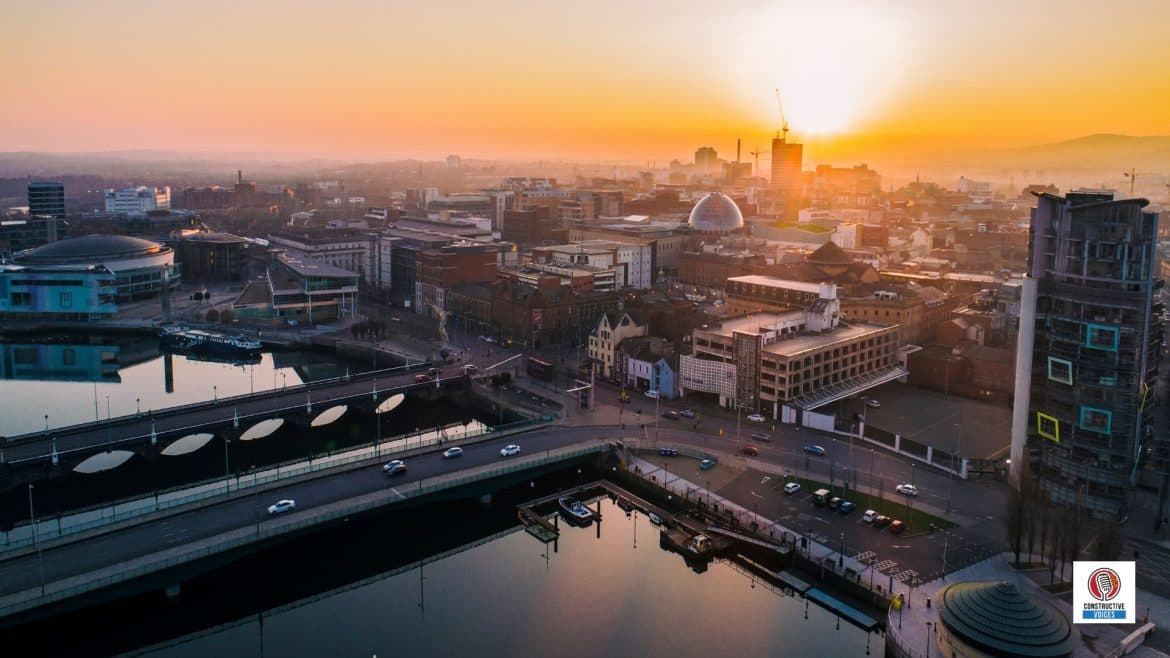
A Victorian boom town reshaped by conflict, Belfast is now working out what a sustainable city looks like when so much of the challenge is about reconnecting people, not just cutting carbon. But Belfast is heading in the right direction, as in 2026, it was ranked 8th in the world's Global Sustainability Destination Index.
Summary
Belfast's architecture comes mainly from two periods: a fast Victorian industrial boom and the Troubles. The boom produced a red-brick and sandstone city of linen warehouses, grand civic buildings and dense workers' terraces. The conflict added peace walls, defensive buildings, severing roads and a hollowed-out city centre. Since the 1998 Good Friday Agreement, development has focused on regeneration and reconnection.
Belfast is not a leading green-architecture city, but sustainable building is growing. Its main strengths are the retrofit and reuse of its large stock of solid Victorian buildings, a coordinated sustainable district in the Linen Quarter, and several landmark projects in the pipeline. Its biggest remaining challenges, such as reconnecting segregated neighbourhoods, are as much about social sustainability as energy performance.
How history shaped the architecture
The industrial boom
Belfast was a small town until the 19th century, then grew rapidly on linen, shipbuilding, rope-making and tobacco. That makes it overwhelmingly a Victorian and Edwardian city, with little older fabric than comparable cities such as Dublin.
Linen warehouses and banks were built to display new wealth, much of it concentrated in what is now the Linen Quarter. Red-brick terraces went up quickly for mill and shipyard workers, and these neighbourhoods were often divided along religious lines from the start, a pattern that mattered greatly later. The Harland & Wolff shipyards, where the Titanic was built, still dominate the harbour skyline through the Samson and Goliath cranes.
- 1888Belfast is granted city status at the height of its industrial growth.
- 1906City Hall is completed, a lavish Baroque Revival statement of a city that saw itself as a rival to Glasgow and Liverpool.
- 1969–1998The Troubles reshape the city through bombing, security measures and segregation.
- 1971The Northern Ireland Housing Executive is established, partly because housing allocation had been a civil rights grievance.
- 1998The Good Friday Agreement opens the way for large-scale regeneration.
- 2012Titanic Belfast opens on former shipyard land, the emblem of post-conflict renewal.
The Troubles
The conflict reshaped Belfast physically as much as socially.
- Peace walls separate Catholic and Protestant neighbourhoods, mainly in north and west Belfast. A 2013 commitment to remove them all by 2023 was missed, and they still limit how people move around the city.
- Defensive design followed from the city centre being enclosed in a security cordon in the 1970s and 1980s. Buildings had blank frontages and inactive ground floors, and the Europa Hotel became known as one of the most bombed hotels in Europe.
- Road building such as the Westlink cut through working-class areas and reinforced divisions between communities.
- Housing went through mass clearance and rebuilding. Some schemes failed badly: the Divis Flats complex in west Belfast was largely demolished in the 1990s, leaving only Divis Tower.
- Decline in the centre from bombing, disinvestment and suburban flight left many gap sites that are still being filled.
Belfast's industrial past left buildings worth reusing. Its conflict past left divided streets that remain its hardest sustainability problem.
Since the peace agreement
Regeneration has aimed to present Belfast as an open, confident city: Victoria Square, the Cathedral Quarter with the MAC and the rebuilt Lyric Theatre, and Titanic Belfast on the old shipyard land. Many former linen warehouses and banks have been converted into hotels, offices and apartments, an early sign of the reuse-led approach that now defines the city's greener building.
Sustainable architecture today
Belfast's sustainability story is a handful of notable projects plus rising pressure from policy and the market, rather than a large, distinctive body of green buildings.
The Linen Quarter sustainable district
In 2021 the Linen Quarter BID launched Northern Ireland's first sustainable district, with ten initiatives aimed at making it the region's most sustainable business area. Its emphasis is on retrofit, and a green building report it commissioned used Bedford House, a nine-storey city-centre tower, to show how similar buildings across Belfast could be upgraded.1
Belfast Stories
The planned visitor and cultural attraction is intended to become the city's leading example of a climate-resilient building, transforming a heritage site in the city centre.2
The Paper Exchange
A mixed-use office scheme to be built to the BREEAM Excellent standard, placing it among the top 10% of sustainable new buildings in the UK. It is part of a wider trend of city-centre offices targeting high green ratings.3
Queen's Business School Student Hub
A new hub on the Riddel Hall campus in south Belfast, designed with sustainable building principles alongside a listed red-brick former student residence.4
The Mackies site
The Take Back the City coalition of families in housing need and design experts is campaigning to turn 25 acres of publicly owned land into sustainable, inclusive housing. Matthew Lloyd Architects won the design competition, chosen from 67 entrants across six continents, for a scheme built around connectivity between communities.5
The profession is also building capacity. HLM Architects has appointed a Passivhaus-certified studio director in Belfast, citing accelerating demand for sustainable and socially responsive projects across Northern Ireland.6
Key takeaways
Belfast's greenest building is often the one already standing. Its Victorian warehouses, banks and offices give it a strong base for retrofit and reuse, and the Linen Quarter shows how that can be coordinated across a district.
New landmark projects such as Belfast Stories will raise the bar, but the city's most important sustainability work may be social: removing peace walls, repairing streets severed by roads, and building shared housing on sites like Mackies.
Sources
- Linen Quarter BID, "RE[act] Building Green", CarbonCopy. carboncopy.eco
- RIBA Competitions, "Belfast Stories". riba.org
- PBC Today, "Grade A office development for Belfast". pbctoday.co.uk
- Archello, Belfast architecture news. archello.com
- e-architect, "Belfast Building News". e-architect.com
- Building of the Year, "HLM Architects strengthens Belfast studio leadership". buildingoftheyear.ie