 Constructive Voices

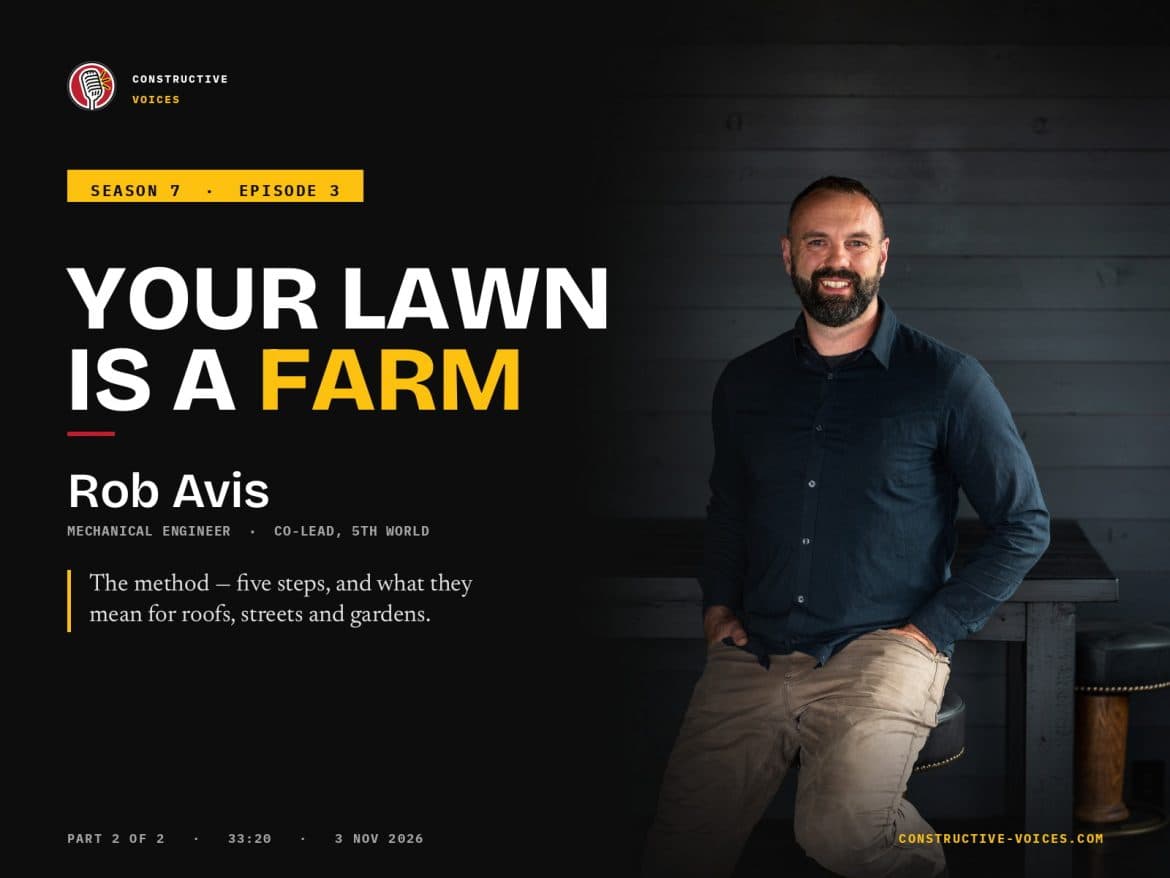

Your Lawn Is a Farm
America grows about as much lawn as it grows wheat — and nobody thinks of mowing as agriculture. Rob Avis does.
3rd November 2026
▶ Listen to Part 2
Listening Time · 33:20
In the second of a two-part series, Jackie De Burca and Rob Avis get practical. How he actually designs a piece of land, what he tells people who are about to buy one, a Calgary school where a market garden did work that indoor sessions could not — and what any of it means for the roofs, streets and gardens that make up the built environment.
About this episode
Part one was the argument. This one is the method.
Rob opens on the house you are probably sitting in. The closest thing to a modern North American home, he says, is a hospital patient: a bedpan to take the waste away, drips bringing in food, water and power, and total dependence on every one of those systems continuing to work. From there he walks through the five-step process he and Michelle set out in Building Your Permaculture Property — values and vision, diagnosis, design, implementation, monitoring — and the Venn diagram at the heart of it: the overlap between what you want from a piece of land and what that land will do effortlessly.
The most affecting passage has nothing to do with engineering. Vaden Sommers runs a school in Calgary for children who have come out of very hard situations, and he has built a market garden, a passive solar greenhouse and an interpretive pond on ground he does not own. Girls arriving off the street, Rob says, are able to heal by nurturing a tomato — and the neuroscience is starting to catch up with why.
Then he turns to the audience listening: the planners, engineers and architects who, he argues, spend their attention on everything from the air barrier inward and almost none on how a building meets the ground around it. Roofs, roads and pavements all become water-harvesting opportunities. Wastewater becomes nitrogen, phosphorus and potassium. And the front lawn turns out to be the largest and least examined farm in North America.
In this episode
Meet the guest
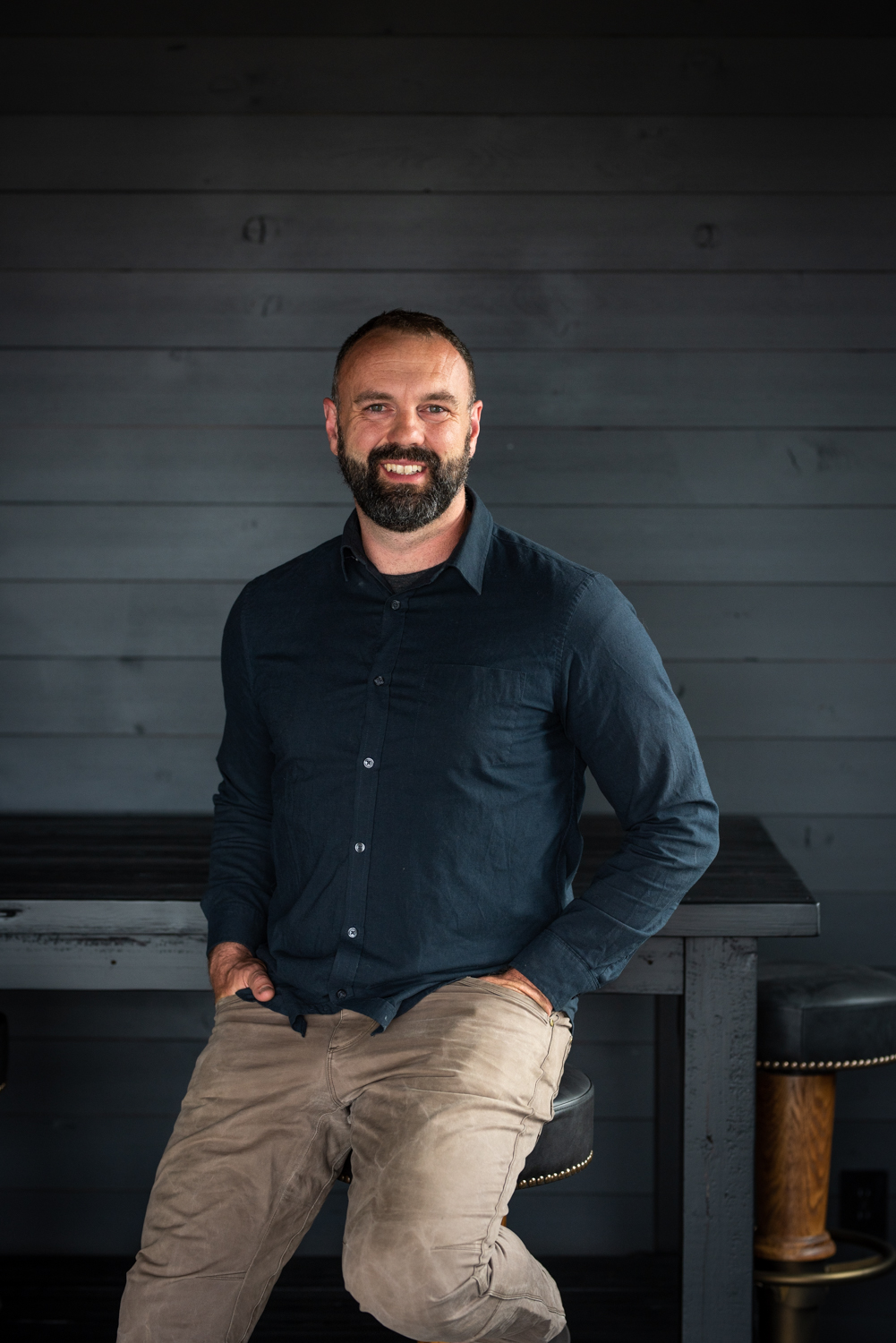
Rob Avis
Mechanical engineer, P.Eng. · Co-lead, 5th WorldRob Avis, P.Eng., is a mechanical engineer who left oil and gas in 2008 to learn how land could be managed better. He co-leads 5th World, designing properties that produce their own food, water and energy, with a focus on cold climates. His team has worked on more than 100 properties across five continents and roughly 40,000 acres. He is the author of two books with New Society Publishers and lives on a 160-acre farm in central Alberta.
In his words
Sewage is not a problem, it's an opportunity. Every problem is just an opportunity.
— Rob Avis, on designing with waste
All the world's problems can be solved through the garden.
— Rob Avis, on Vaden Sommers's work at Hull Services
It's the aggregate of our individual life decisions that actually lead us to where we're going.
— Rob Avis, on why this isn't someone else's problem
Explore further
- 5th World — Rob's design-build practice
- 5th World case studies — passive solar greenhouses, community orchards and regenerative homesteads
- Building Your Permaculture Property (New Society Publishers) — the five-step process this episode walks through
- Rob's second book, on rainwater harvesting
- Hull Services, Calgary — where Vaden Sommers built the garden Rob describes
- Howard T. Odum — the ecologist behind the maximum power principle
- Water harvesting in Tucson, Arizona — the re-greening case study Rob cites
Start at the beginning
Guest: Rob Avis, P.Eng. (5th World)
Host: Jackie De Burca
Series: Season 7, Episodes 2–3 — a two-part Constructive Voices interview
Constructive Voices is an independent podcast on sustainability and the built environment. If you enjoyed this episode, please rate and review us on your podcast app — it helps others find the show.