 Constructive Voices
Tracing the History of Green Building in Azerbaijan
9/10/2023

Azerbaijan · Green Building · History
Tracing the History of Green Building in Azerbaijan
Azerbaijan’s green-building story runs from a remediated oil district in Baku to a national renewable-energy programme and a post-conflict reconstruction billed as a green zone. It is a history of ambition, and of the gap between flagship projects and the buildings most people live in.
Green building arrived in Azerbaijan the way it arrived in much of the post-Soviet world: not as a grassroots movement but as a piece of national modernisation. The driver was a city — Baku — that was rebuilding itself on the proceeds of oil, and a state that wanted the built environment to signal a break with the industrial past. What followed over roughly fifteen years was a sequence of landmarks: the remediation of the Black City industrial belt, the launch of Baku White City, the founding of a green building council, an explicit commitment to the UN’s sustainable development agenda, and then, much more recently, the hosting of COP29 and a national target for renewable energy.
This history matters beyond Azerbaijan because it is a common pattern. Countries with hydrocarbon economies are often the ones where the language of sustainability is most contested, and where the distance between the showcase and the ordinary building is widest. Azerbaijan is a clear case study of both the ambition and the gap, and of a state that has begun to use the built environment as its primary domestic evidence of climate seriousness.
This report traces that history in order, from the early regeneration projects through the institutional and policy steps, to the present moment in which Baku’s skyline and the reconstruction of Karabakh are being asked to carry the country’s environmental credibility.
From Black City to a modern skyline
Baku’s green-building history begins in the Black City, the industrial belt that grew up around the oil fields on the city’s outskirts. For most of the twentieth century it was a landscape of refineries, workshops, derricks and contaminated ground — the physical residue of the industry that made the city wealthy. Its rehabilitation, with the support of international engineering expertise, was one of the earliest and largest brownfield remediation efforts in the region, and it turned a problem into an asset: a large area of serviced land close to the centre, ready to be redeveloped.
That land became Baku White City, launched in 2011 as an urban regeneration project that set out to convert the former industrial zone into a modern, mixed-use waterfront district. The plan combined residential, commercial and leisure uses with a substantial amount of green and public space, and it introduced a vocabulary of sustainable urban design that had not previously been part of the city’s development debates. Whether or not every element was delivered as drawn, White City established the precedent that redevelopment in Baku could be discussed in terms of environmental quality, not only density and cost.
White City is instructive precisely because it was a planning exercise as much as an environmental one. Remediating the land and reconnecting the district to the waterfront was the environmental gain; the social gain was the provision of public space in a city that had little of it along the shore. It also normalised the idea that Baku’s development should be judged on more than plot ratios — a shift in expectation that later projects inherited.
The same period saw the city’s new landmark buildings — the Flame Towers, the Heydar Aliyev Center and the Crystal Hall — establish a high-specification construction culture in the capital. These were not green buildings in a certification sense, but they demonstrated that complex, high-performance envelopes and building services could be designed and built in Azerbaijan, which is the technical precondition for any credible green-building market.
Sources: Constructive Voices, Azerbaijan green building; COP29 Azerbaijan, Baku as host city.
A green building council and a standards push
The institutional turn came in 2013 with the founding of the Azerbaijan Green Building Council (AzGBC), a non-profit body established to promote sustainable construction, provide certification and training, and disseminate information on green-building principles and technologies. In a market where most practitioners had been trained under Soviet norms and where energy had long been cheap, the council’s role was as much educational as technical.
Its work sat alongside a broader adoption of international tools. Developers and consultants in Baku began to use international rating systems — LEED, BREEAM and their regional relatives — to benchmark projects, and the country’s professional bodies started to organise the workshops, conferences and exhibitions that a nascent industry needs. The Port Baku Residential Towers, completed in 2016, became the most visible example, marketed on energy-efficient systems, water-saving technologies and green space, and recognised within the construction sector for those features.
The significance of this period is less in any single certified building than in the creation of a professional vocabulary and a set of reference projects. Green building in Azerbaijan moved from an imported concept to a domestic expectation for high-end development — which is progress, though it also set the expectation that green was something for premium towers.
Sources: United Nations, the 2030 Agenda for Sustainable Development; Constructive Voices, green building in Azerbaijan.
From commitment to regulation
In 2015 Azerbaijan joined the United Nations’ 2030 Agenda for Sustainable Development, aligning its long-term plans with the Sustainable Development Goals. That commitment gave the country a framework within which to place green building, and it was followed by concrete measures aimed at the construction sector: energy-performance requirements for new buildings, incentives for energy-efficient housing, and a green-mortgage programme introduced by the State Agency for Housing Construction to offer preferential terms for efficient homes.
The policy logic was straightforward. Azerbaijan’s buildings were energy-intensive, its energy was cheap, and the combination produced waste that showed up both in household bills and in national emissions. Building codes that enforce performance standards are the most direct lever a government has over that, and they are more consequential than any voluntary certification scheme because they bind every project, not just the ones seeking a plaque.
The pace and enforcement of those codes is the part of the story that is hardest to verify from outside. Azerbaijan has the framework of a modern construction-regulation regime; the question that recurs in the sector is how consistently the performance requirements are designed, inspected and met in practice, particularly outside Baku and particularly in the residential market where cost pressure is greatest.
Who builds green, and why
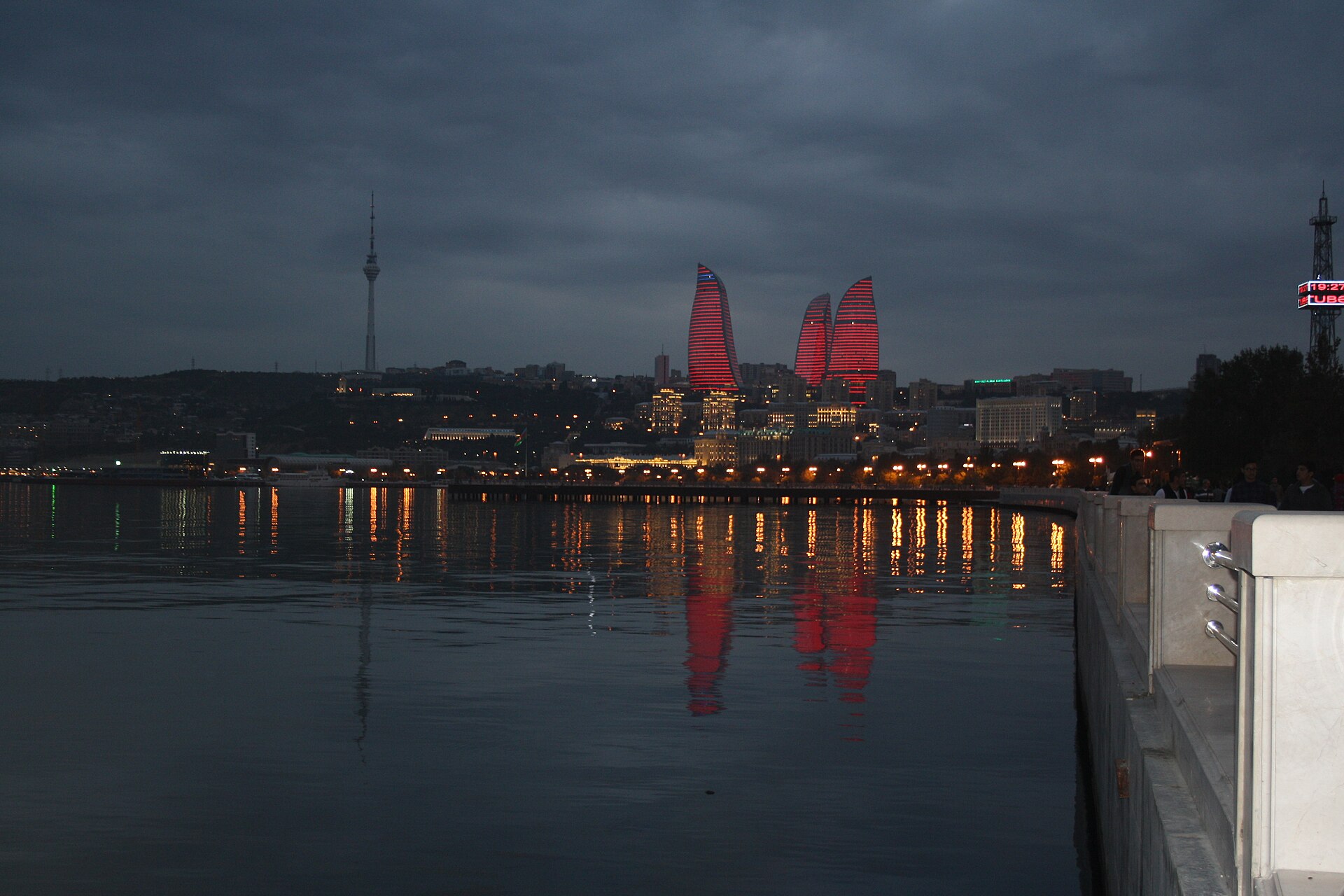
Green building in Azerbaijan has been driven less by occupant demand than by three other forces: the state as client, international finance, and reputation. The state commissions a large share of major construction — public buildings, infrastructure, the Karabakh programme — and when the state decides that performance standards matter, they are applied. International lenders and investors bring their own environmental and social requirements, which push projects toward recognised standards. And in a city where the skyline is a statement, a green certification carries prestige for the developer.
What is largely absent is the fourth force that drives green building in mature markets: a broad base of buyers who value efficiency and will pay for it. Energy in Azerbaijan has historically been cheap, which removes the household incentive to demand better-performing buildings, and the resale market does not yet price energy performance in a way that rewards it. Until that changes, the economics of green building rest on regulation, financing conditions and prestige — which means they rest on decisions made by a relatively small number of actors.
The professional dimension follows the same pattern. Azerbaijan now has architects, engineers and consultants who have worked on internationally certified projects, and it has a green building council that trains and certifies. The constraint is scale: the number of practitioners with green-building expertise is small relative to the volume of ordinary construction, and the skills needed for deep retrofit — as opposed to new-build certification — are scarcer still.
Sources: United Nations, 2030 Agenda; Constructive Voices, green building in Azerbaijan.
Sources: United Nations, 2030 Agenda; State Housing Construction Agency (MIDA), agency record.
Renewables become the centre of the plan
The most important shift of the past five years is that green building has been subsumed into a much larger national project: the transition of Azerbaijan’s energy system. The country has set out to scale up solar and wind generation, opened its renewable-energy market to international developers, and pursued cross-border electricity links toward Türkiye, Georgia and Europe. The Garadagh solar plant, developed with foreign investment, and a series of wind projects in the Absheron and Caspian areas are the leading edge of that programme.
For the built environment, this changes the arithmetic. A building’s environmental impact depends on both its efficiency and the carbon intensity of the electricity it consumes; a grid with more renewables makes every efficient building cleaner and makes electrification of heat and transport worthwhile. Azerbaijan’s commitment to renewables is therefore a green-building policy even where it looks like an energy-export policy, and the country’s energy diplomacy — including plans to move Caspian wind power toward the EU — is part of the same story.
The pivot also creates the tension that runs through the whole sector. Azerbaijan is a major gas producer, and its new renewable capacity is being built alongside continued hydrocarbon extraction rather than instead of it. In the built environment the equivalent tension is between showcase projects that perform at international standard and a large existing stock that does not.
A second, less visible front is materials. The emissions of a building are not only the energy it uses in operation but the carbon embodied in its concrete, steel, glass and finishes — a share that grows as grids decarbonise. Azerbaijan’s construction industry is materials-intensive, and the country has the raw materials, the cement and the aggregates to supply itself. Whether that becomes a low-carbon advantage or a high-carbon liability depends on whether embodied carbon enters procurement and design decisions. It is the part of green building that has the least public profile and the largest long-term effect.
Sources: AzerNews, Azerbaijan’s wind boom; Hürriyet Daily News, renewable exports via Nakhchivan.
COP29 and the credibility test
Hosting COP29 in Baku in November 2024 moved Azerbaijan’s environmental credentials onto the world stage and, inevitably, invited scrutiny of them. The conference produced the “Baku finance goal” on climate finance for developing countries, and it put the host’s own economy in the spotlight: an oil-and-gas state chairing the world’s climate talks is a contradiction that commentators did not allow to pass. Azerbaijan’s answer has been to present itself as a country in transition — a fossil-fuel producer that is also investing in renewables and rebuilding a conflict-affected region on green principles.
The summit’s built-environment legacy is more durable than its communiqué. Hosting a COP accelerated investment in Baku’s transport, accommodation and public realm, and it forced the city to present its best face — which in practice meant new construction at a higher specification than the market would otherwise have produced. That is a real, if indirect, green-building outcome: a conference is, among other things, a deadline for infrastructure.
Since the summit the country has kept up the momentum: it has been announced as host of World Environment Day 2026 and has bid to host the UN biodiversity conference COP17. For the built environment, the hosting carries an obligation that is more concrete than the diplomacy. The infrastructure built for a COP — venues, transport, accommodation — and the standards applied to new construction around it become the visible evidence of whether the country’s environmental language is matched by its buildings.
The gap between hosting and delivery is the honest theme of this history. Azerbaijan has demonstrated that it can build to a high standard, convene the world and set national targets. Whether green building becomes the default rather than the exception is the question that the next decade will answer.
Sources: Carbon Brief, COP29 key outcomes; World Environment Day 2026, official site.
Karabakh as a green-building laboratory
The newest chapter in Azerbaijan’s green-building history is being written in Karabakh. After the 2020 war and the 2023 displacement, the state committed to reconstructing the region on a “smart” and “green” basis: renewable-powered districts, energy-efficient buildings, and a stated ambition to make the liberated territories a green energy zone. On paper this is the most ambitious green-building programme the country has attempted, and it is being planned from a clean sheet rather than retrofitted onto existing cities.
It is also the chapter where the stakes and the controversy are highest. Reporting by Climate Home News and The Conversation has documented concern that hydropower development, road-building and mineral extraction in ecologically sensitive areas risk being branded green while causing real environmental damage. The region’s forests and rivers had already suffered from the conflict and from years of neglect, and reconstruction is the moment their future is decided.
The green-building dimension of that debate is precise. A district powered by renewables and built to high efficiency standards is genuinely lower-carbon; the same district, if it is sited across a wildlife corridor or built with materials quarried from a protected forest, can be environmentally harmful overall. Azerbaijan’s earlier flagship projects were judged on their architecture. Karabakh will be judged on its siting and its cumulative impact — a harder and more honest test.
Sources: Climate Home News, Azerbaijan’s net-zero vision clashes with war legacy; The Conversation, Baku and the green movement.
The ordinary building problem
Read as a history, Azerbaijan’s green-building record is a story of a market that has developed at the top and not yet at the bottom. The country can deliver international-standard towers in Baku and plan renewable-powered districts from scratch; it has a green building council, energy-performance rules and a sustainable-development commitment. What it has not yet done is transform the energy performance of the buildings where most people live and work.
A large share of Azerbaijan’s housing stock dates from the Soviet period and was designed around subsidised energy: panel apartment blocks with uninsulated walls and single-glazed windows, served by district heating that was built for supply rather than efficiency. Upgrading that stock — insulation, windows, heating controls, and in many cases the heat source itself — is the single largest built-environment emissions task in the country, and it is not the kind of work that produces a landmark. It is also social policy as much as climate policy, because the households in the least efficient buildings are usually the least able to pay for improvements.
The retrofit problem is also a heating problem. Many Azerbaijani cities are served by district heating systems built decades ago around centralised supply, and the efficiency of that heat depends on the pipes, the boilers and the controls as much as on the buildings. Upgrading a district-heating network is a public infrastructure project, not a private renovation, which places it beyond the reach of individual owners. It is the kind of task that only the state or a regulated utility can lead, and it is the reason the country’s built-environment emissions will not fall on the strength of private decisions alone.
That is the gap the next phase of Azerbaijan’s green-building history has to close. Flagships prove what is possible; codes and retrofit programmes determine what is normal. The country now has enough of the first. The measure of the coming decade will be how much of the second it can deliver.
Sources: United Nations, 2030 Agenda; Constructive Voices, green building for a sustainable future.
How to read this history honestly
Three cautions are worth carrying. The first is that dates and milestones in this account are drawn from the sector’s own reporting and from company and government sources, and some — particularly the timing and scope of early projects — are difficult to verify independently. The second is that the existence of an institution, a code or a commitment is not evidence that it has changed outcomes; the useful question is always what was built and how it performs. The third is that Azerbaijan’s history is unusually exposed to the country’s political economy. When the state is the principal client, the standard-setter and the host of the world’s climate conference, the boundary between environmental policy and national image is thin, and green building can serve both.
Read with those cautions, the history is nonetheless clear. Azerbaijan moved, in about fifteen years, from a city defined by its oil industry to one that talks about sustainability as a development goal, built a professional green-building community, committed to renewable energy and began rebuilding a region on green principles. It did so as a hydrocarbon state, without resolving the contradiction at its centre. That is not unusual. It is the condition in which most of the world’s green-building transitions are actually taking place.
Key milestones
2011 — Baku White City regeneration launched on rehabilitated industrial land. 2013 — Azerbaijan Green Building Council founded. 2015 — Azerbaijan joins the UN 2030 Agenda. 2016 — Port Baku Residential Towers completed and recognised for efficiency features. 2017 — green mortgage programme introduced by the housing agency. 2024 — Azerbaijan hosts COP29 in Baku. 2026 — announced host of World Environment Day, bid to host COP17.
Sources: Constructive Voices, history of green building in Azerbaijan; Carbon Brief, COP29 outcomes.
Frequently asked questions
When did green building start in Azerbaijan?
The modern chapter begins around 2011 with the Baku White City regeneration project and the rehabilitation of the former Black City industrial area, followed by the founding of the Azerbaijan Green Building Council in 2013.
What is the Azerbaijan Green Building Council?
A non-profit body founded in 2013 to promote sustainable construction, provide certification and training, and disseminate information on green-building principles and technologies.
What was Baku White City?
A major urban regeneration project launched in 2011 to convert the remediated Black City oil-industrial belt into a mixed-use waterfront district with residential, commercial, leisure and green space.
Which green building projects are notable in Azerbaijan?
Baku White City, the Port Baku Residential Towers (2016), and newer renewable-linked developments. The Garadagh solar plant and wind projects underpin the energy side of the transition.
How has COP29 changed green building in Azerbaijan?
It put the country’s environmental credentials under international scrutiny and reinforced its presentation as a transition economy. It also raised the standard that domestic construction is judged against.
What is the biggest remaining challenge?
Retrofitting the Soviet-era housing stock — uninsulated panel blocks with single glazing and inefficient heating — which is the largest built-environment emissions task and the least glamorous.
More on Azerbaijan
AzerbaijanBiodiversity: species and what is under threat
AzerbaijanGreen building for a sustainable future
Primary sources and news citations
- Carbon Brief, COP29: key outcomes agreed at the UN climate talks in Baku.
- COP29 Azerbaijan, official conference record.
- World Environment Day 2026, official national site.
- United Nations, Transforming our world: the 2030 Agenda for Sustainable Development.
- AzerNews, Azerbaijan’s wind boom.
- Hürriyet Daily News, Azerbaijan to export renewable energy to Türkiye via Nakhchivan.
- Climate Home News, In Nagorno-Karabakh, Azerbaijan’s net-zero vision clashes with legacy of war.
- The Conversation, Nagorno-Karabakh: Baku and the green movement.
- Constructive Voices, Embracing Azerbaijan green building for a sustainable future.
Methodology and sourcing. Milestone dates and project descriptions are drawn from the sector’s own reporting, company and government sources, and are presented as documented claims rather than independently verified facts. Where a project’s green credentials are contested — notably the Karabakh reconstruction — the report states the competing positions. This report describes the position as at September 2026.

Latest Episode
S7, E4: Infrastructure vs Nature Is the Wrong Fight: Joel Humphreys