 Constructive Voices
Green Buildings in Valencia: Sustainable Architecture & Routes
12/3/2025

Green Buildings in Valencia
Valencia City’s Sustainable Buildings in Clusters to Explore
By Jackie De Burca, creator, podcaster and author of Salvador Dalí at Home
Valencia is not only a green city, but it is also a region – called the Comunidad Valenciana.
In 2024, Valencia was the European Green Capital. Little did anyone know that towards the end of the year, southern parts of the city would lose lives and go through terrible tragedy with the floods – the Dana.
In this article, we will explore some of Valencia’s top green buildings.

Valencia floods 2024 clean up by Patricia Sousa Sardinha
After the announcement of Valencia being the European Green Capital, Paola Llobet, Valencia’s councillor for tourism and innovation said:
“I think it’s a recognition by the European Community of our common work…it’s something that we, as a community, have been building for years, within neighbourhoods. We have been protecting our orchards, our beaches, our sea, the Albufera natural park and more.” Paola Llobet
It is a flat, outwardly gentle city, hemmed in by huerta and sea, but it has never had a gentle relationship with water. The old riverbed that now feels so benign, planted and full of joggers and cyclists, is in fact a scar from a flood that almost broke the city. The same one that is part of the reason for the floods in 2024.
“But the city offers green spaces to 97% of its residents. The light can be soft and pearly in winter, then glaringly bright and unforgiving in August, bouncing off stone and glass until the streets feel slightly dazed. The heat of the summer of 2025 was the worst I have known to date.” Jackie De Burca


Cluster 1 – Turia River and the City of Arts and Sciences
As you make your way towards the Turia River and the City of Arts and Sciences, apart from being impressed it is interesting to ponder a while on the history of this area.
Considered part of the lungs of Valencia city today, this area was transformed from he former riverbed into the Jardín del Turia after the catastrophic 1957 flood. The linear park project turned about 120 hectares of old riverbed into green infrastructure and was developed late in the 20th century.
Approaching the old riverbed, follow it slowly towards the white silhouettes of the City of Arts and Sciences. The buildings at the end of this green corridor are now going through their own, slower transformation.
CaixaForum València – A Second Life Inside a Shell
On the map: Inside the Ágora building, City of Arts and Sciences, 46013 València.
Nearest metro: Alameda or Aragón, then cross the Turia gardens on foot.

Valencia CaixaForum
The Ágora was for years an impressive but uneasy presence: a tall, metallic shell that photographed beautifully and yet often stood half empty, too large and too raw for everyday use.
CaixaForum enters the story like a careful but determined house guest, bringing furniture, light and a different way of inhabiting the space. A new world of suspended rooms, walkways and viewing platforms has been threaded into the belly of the existing structure. Where once there was just an echoing volume, you now have a series of smaller, more precise spaces that can actually be occupied, heated, cooled and lit with some sense.
Key data: Several thousand square metres of gallery, education and public space inserted within an existing 75-metre-high steel envelope, turning a rarely used shell into a working cultural building.
Key players: Original structure by Santiago Calatrava; interior transformation by Enric Ruiz-Geli / Cloud 9 with collaborating teams; client, “la Caixa” Foundation.
Stand to one side and read the layers: original steel skin, new inner “landscape”, bridges and stairways. It is a live example of densifying a prestige container instead of discarding it.
Follow the routes of air, light and services. Ask yourself whether the intervention has genuinely tamed the climate inside, or if there are still moments where spectacle wins over comfort.
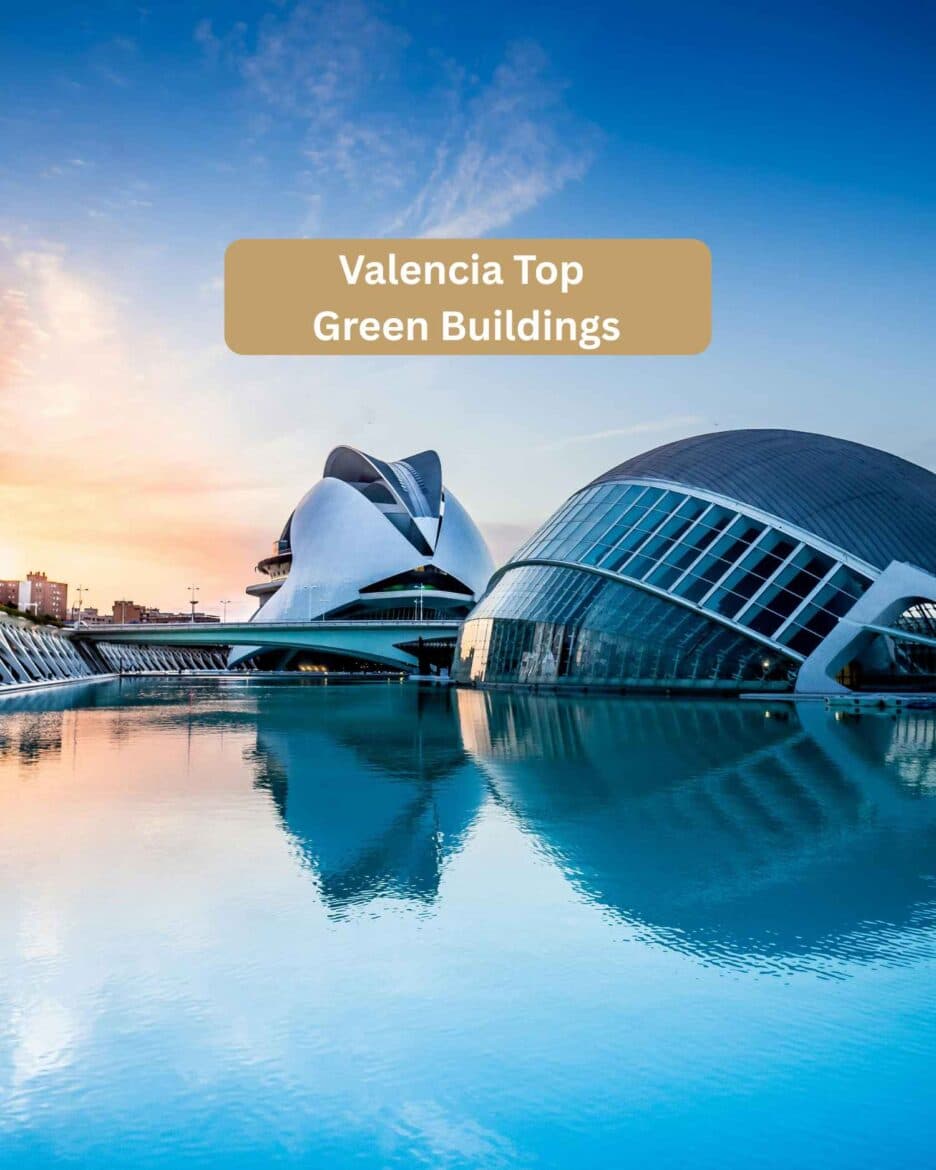
Museu de les Ciències – The Futurist Body Undergoing Surgery
On the map: Museu de les Ciències, Av. del Professor López Piñero 7, 46013 València.

Valencia Museu de les Ciències
The City of Arts and Sciences sits in this broader urban reinvention. The complex occupies a large site in the former Turia river area and was conceived as a cultural/scientific ensemble linking the centre toward the sea.
It’s not typically held up as a “low-carbon” model, but it is part of the city’s story of repurposing and reimagining infrastructure and landscape.
This long, skeletal museum stretches along the former river like a beached creature. Its exposed ribs, great panes of glass and lofty interiors came out of a time when energy was cheap and “futuristic” meant white, bright and oversized. The city is now slowly, and quite bravely, subjecting this body to technical surgery. Under the same familiar shell, work is underway to connect the complex to a large geothermal field, to lay out photovoltaic arrays, and to renew plant and controls, so that the ground and the sun start to carry more of the load that used to fall on electricity alone.
Key data: A multi-megawatt geothermal and renewable upgrade programme aimed at saving hundreds of thousands of kilowatt-hours per year and significantly cutting CO₂ emissions for the museum complex.
Key players: Original architecture by Santiago Calatrava; upgrade programme led by the City of Arts and Sciences organisation with specialist engineering teams under national and municipal funding schemes.
Walk along its length and look for the new clues: shafts, plant rooms, panels, small changes that tell you the building is being rewired while keeping its original bones.
It is a good place to think honestly about how far services can compensate for a form that was never designed for today’s climate pressures, and where the limits of that strategy lie.
Cluster 2 – Avinguda de les Corts Valencianes
Solar Gestures and Quiet Benchmarks
Shift now to the broad avenue of Corts Valencianes, where the city stands more upright: towers, hotels, traffic in wide streams. Here, green intentions are expressed very differently – not in white curves over water, but in metal roofs, conference timetables and office fit-outs.
Palacio de Congresos de València – A Leaf Turning Towards the Sun
On the map: Avinguda de les Corts Valencianes 60, 46015 València.
Nearest tram/metro: Beniferri, a short walk away.

Courtesy of Palacio de Congresos de València
The conference centre sits slightly off the line of the avenue, as if it has turned its back on the hardest noise and heat. A shallow pool, trees and landscaped mounds soften the approach. Above this, a generous roof sweeps out like a protective wing, shading the glazed facades and, crucially, carrying a large photovoltaic field. What could have been an ornamental gesture has been asked to work much harder, harvesting sunlight to feed the building itself and feeding back into the grid when events fall quiet.
Key data: A solar roof with thousands of photovoltaic modules spread across roughly eight thousand square metres, generating hundreds of megawatt-hours per year and avoiding several hundred tonnes of CO₂ emissions.
Key players: Architect, Foster + Partners; engineering support from international and local teams; client, the City of Valencia.
Take time to walk the whole perimeter. Seen slowly, the roof, water and planting read as one continuous microclimate device, rather than separate decorative elements.
Inside, if you can, think about the rhythm of the building’s use – peaks during conferences, long pauses between them – and how well its energy systems map onto that pattern.
CV15 Efficient Offices – The Everyday Line in the Sand
On the map: Avinguda de les Corts Valencianes 15, 46015 València, a short stroll from the conference centre.

Courtesy of CV15 office building
CV15 is not an object building. You could almost pass it by, fold it mentally into the row of other offices and hotels. Yet this is precisely where it becomes interesting.
Behind a controlled combination of glass and solid elements, the building has been designed and certified to meet contemporary environmental standards. The envelope is tuned to Valencia’s light and heat, the mechanical systems and controls are specified to keep consumption down, and there is provision for electric vehicle charging below ground. It is the sort of building that tells you what “normal” should already be.
Key data: High-performing office building with international green-building certification, designed around energy efficiency, indoor environmental quality and sustainable mobility.
Key players: Developer and owner, CV15 Efficient Offices; design and engineering by a local multidisciplinary practice with a focus on sustainable commercial projects.
Use it deliberately as a benchmark: if a new office block in the city cannot match or surpass this level of thoughtfulness, then it is, by definition, behind.
If you are able to see the interiors, pay attention to very simple measures of success: daylight in work areas, noise levels, air movement. They often reveal more than a long list of technical features.
Cluster 3 – Housing, Gardens and the Long Arc of Comfort
Cooperatives, Courtyards and Concrete Landscapes
The third group of buildings is quieter, but in many ways more telling. Here you are no longer in the world of cultural flagships and grand events, but in the slower, intimate realm of housing: where people sleep, argue, hang washing and grow plants. It is here that Valencia’s relationship with climate and comfort becomes very concrete.
Espai Verd – A Vertical Garden Settlement
On the map: Carrer del Músic Hipòlit Martínez 16, 46020 València, in the Benimaclet district, close to the edge of the huerta.

Espai Verd courtesy of OpenHouseValencia
Espai Verd rises from the urban fabric like a steep, irregular hill, its terraces heavy with earth, trees and shrubs. Balconies, patios and gardens are stacked one above the other, so that many homes feel less like units in a block and more like individual houses embedded in a shared topography.
Paths, stairs and courtyards wind through the structure, connecting private spaces with communal ones in a way that blurs the usual line between “my flat” and “the building”. Heat here is not fought purely with machines: shade, evapotranspiration from the plants and the sheer thickness of the structure do a great deal of slow, patient work.
Key data: Around one hundred dwellings of varied types arranged on stepped terraces in a reinforced-concrete frame designed to support significant soil and planting loads.
Key players: Architect, Antonio Cortés Ferrando; promoted as a housing cooperative; engineering shaped around the combined weight of landscape and housing.
It is worth walking the building twice: once from the outside, reading it as a piece of constructed topography, and once from the interior routes, feeling how the gardens mediate light, noise and temperature.
Think about time and stewardship. Much of what you see now – the density of planting, the small interventions – is the result of resident decisions layered onto the original design over the course of decades.
Santa María Micaela Cooperative Housing – A Courtyard That Knows Its Climate
On the map: Access from Carrer Santa María Micaela 18, close to Avinguda Pérez Galdós, 46008 València.

Santa María Micaela Cooperative Housing courtesy of OpenHouseValencia
At first sight, Santa María Micaela presents itself as an ordinary mid-century cooperative: restrained facades, three blocks enclosing a generous central courtyard, no spectacular gestures. Yet when you start to trace lines of air, light and movement, a different picture appears.
The proportions of the courtyard, the height of the blocks and the depth of the galleries allow air to move, create bands of shade and keep direct summer sun away from the most vulnerable surfaces, while still admitting welcome winter light. It is a quietly intelligent piece of urban housing that has become a reference case for how to retrofit similar estates today.
Key data: Three mid-twentieth-century residential blocks around a central planted courtyard, now studied as a model for energy and comfort upgrades with minimal structural intervention.
Key players: Original architect, Santiago Artal; client, a commercial agents’ cooperative; more recently, academic teams using the estate as a test bed for Mediterranean bioclimatic retrofit strategies.
Try to visit at different times of day. Morning, noon and evening will each reveal different shadows, reflections and breezes, which tell you more about the real performance of the place than any drawing.
Consider what could be added – better insulation, improved windows, more planting – without destroying the underlying logic. It is a useful mental exercise in working with, rather than against, what is already there.

Thread These Valencian Green Buildings Together
If you want the walks to form a coherent story rather than isolated visits, you might try this sequence.
Day 1 – River, Shells and Second Chances
Start in the Turia gardens and let them lead you, gently, towards the white silhouettes of the City of Arts. Spend time with the science museum and the wider complex, looking for the ways in which technical upgrades are being grafted onto uncompromising forms.
Then move into the Ágora and CaixaForum, and read the new inner architecture as a statement about reuse: how a city can choose to inhabit its past bravado more intelligently.
Day 2 – Avenue, Offices and Housing Landscapes
Begin on Avinguda de les Corts Valencianes, contrasting the overt solar gesture of the Palacio de Congresos with the quieter, benchmark ambition of CV15. In the afternoon, cross back into the fabric of the city for Santa María Micaela, and end the day in Benimaclet at Espai Verd, with the open farmland not far away. It is an apt closing image: housing conceived as a kind of cultivated slope, somewhere between urban block and hillside garden.
Latest Episode
S6, E2: Living With Water: The Philosophy Behind Cork's Marina Park