

Ireland Biodiversity and the Built Environment
- Jackie De Burca
- August 8, 2026
Ireland is building 300,000 new homes into a landscape where 90% of EU-protected habitats are already in unfavourable conservation status and 51% are actively deteriorating. The construction sector is not a bystander in this collapse: it accounts for roughly 37% of national carbon emissions and was the only Irish sector where emissions rose in 2024. With the Nature Restoration Regulation now binding Ireland to no net loss of urban green space by 2030, measures like Dublin's Policy SI23 — mandating green roofs on all developments over 100 sq m — are shifting from aspiration to compliance. The Portrane forensic hospital case shows what early ecological input can achieve: redirecting drainage to a dying wetland restored habitat, solved surface water attenuation, and saved roughly €100,000 over a conventional tank.
Ireland Biodiversity and the Built Environment
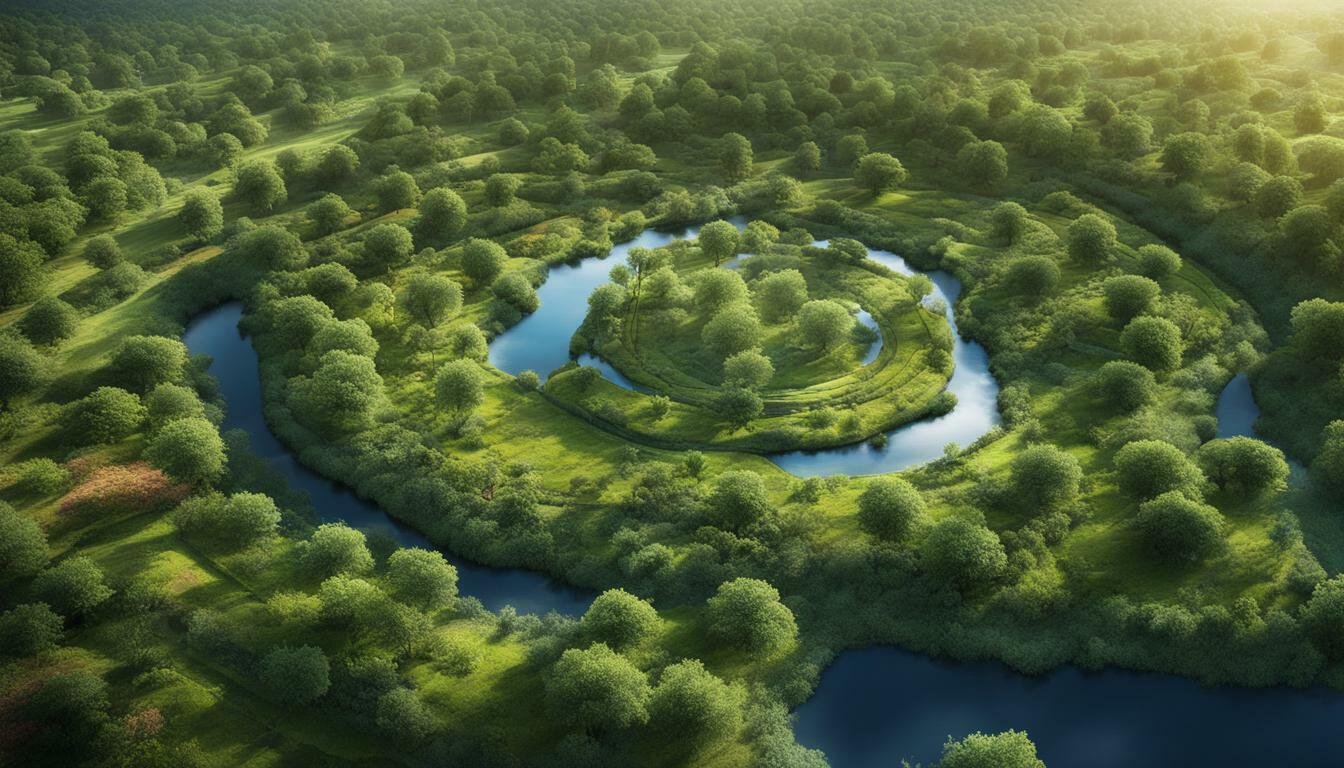
You can still see rural landscapes like this in Ireland. The local people might greet you with, “Soft day, thank God.” These places are examples of romantic Irish bliss to our country’s visitors, but sadly are not representative of much of the living, working country.
A country where two emergencies collide on the same piece of land.
This analysis investigates both of these and how the lack of a single Biodiversity Act plays out in all of this.
Ireland · Deep dive
Biodiversity
and the Built
Environment
Ireland is building 300,000 homes into a landscape where nine in ten protected habitats are already failing. This is what the evidence says about doing both.
How to read the colour in this document
This palette is not decorative. It is the colour scheme the EU uses to report conservation status under Article 17 of the Habitats Directive — green for favourable, amber for unfavourable-inadequate, red for unfavourable-bad. Applying it to policy, cost and practice is the organising idea of this piece.
Two emergencies, one building site
Every May, a bird arrives over Irish towns that has not touched the ground since it left them the previous August. The common swift sleeps on the wing, feeds on the wing, and mates on the wing. It comes down for one reason only: a crack in a wall.
Increasingly, it doesn't find one.
That small architectural fact — the disappearance of gaps — is a useful way into a much larger story, because it is the story of two national projects colliding on the same piece of ground.
The first is to build roughly 300,000 new homes between 2025 and 2030: around 50,000 a year, plus the roads, water infrastructure and schools that must come with them. It is the defining public policy commitment of the decade.
The second is to stop a biodiversity collapse already well advanced. Ireland's most recent Article 17 assessment — submitted August 2025, published that December — found that 90% of Ireland's EU-protected habitats are in "unfavourable" conservation status, with 51% actively deteriorating.
Nine in ten. That is the ground onto which 300,000 homes are going.
Buried in that gloom is the most important number in the report: 9% improving. NPWS traced those gains to two things — Bord na Móna's bog restoration programme and decades of patient work on the lesser horseshoe bat.
Nature answers when you call it. It just wants the call sustained, funded, and repeated for twenty years.
Ireland declared a Biodiversity and Climate Emergency in 2019, one of the first countries in the world to do so. It was a Dáil motion rather than legislation — a statement of intent, not a statute — but it was the moment biodiversity stopped being a heritage matter and became a planning one.
Construction is not a bystander here
There is a comfortable version of this conversation in which buildings are neutral objects and biodiversity loss happens somewhere else — on farms, in bogs, out of sight. It doesn't survive contact with the evidence.
IPBES identifies five main drivers of global biodiversity loss. The built environment has direct, traceable links to four of them.
| IPBES driver | How the built environment contributes |
|---|---|
| Land-use change | Site clearance, soil sealing, habitat fragmentation, greenfield development, hedgerow removal |
| Climate change | Operational and embodied carbon; Irish construction and the built environment account for roughly 37% of national carbon emissions |
| Pollution | Sediment and chemical runoff during construction; light and noise spill; surface water contamination |
| Invasive alien species | Spread via contaminated soil, machinery and imported plant stock |
| Overexploitation | Indirectly, through raw material extraction in the supply chain |
Then there is the part nobody sees. Most of the sector's ecological damage happens nowhere near the site. It happens in the quarry, the forest, the smelter, the cement works. The hoarding line marks the boundary of our attention, not the boundary of our impact.
The UK Green Building Council calls this "embodied ecological impacts" — a phrase built deliberately to rhyme with embodied carbon, and to shame us into measuring it the same way. Irish practice has barely started.
The Climate Change Advisory Council found that the built environment was the only sector in Ireland where emissions rose in 2024. Everything else — transport, agriculture, energy — went the other way. Construction went up alone.
The rule book: what actually bites
There is no single "biodiversity law" for Irish construction, which is precisely the problem. There are layers — European regulation, national statute, planning policy, voluntary standards — and the skill is knowing which of them has teeth on your particular site.
| Instrument | Type | What it does for the built environment |
|---|---|---|
| Habitats Directive (92/43/EEC) | EU Directive, transposed 1997 | Triggers Appropriate Assessment / Natura Impact Statement where a project may affect SACs and SPAs; strict protection for species including all bats |
| Birds Directive (2009/147/EC) | EU Directive | Protects wild birds and their nests; underpins SPA designations |
| Wildlife Acts 1976–2023 | National statute | Protects species and nests; governs derogation licences for works affecting bat roosts |
| Wildlife (Amendment) Act 2023 | National statute | Introduced a public sector biodiversity duty — listed public bodies must have regard to the NBAP and report on progress |
| National Biodiversity Action Plan 2023–2030 | Statutory plan | Ireland's first NBAP on a statutory footing; 194 actions; whole-of-government approach |
| Nature Restoration Regulation (EU) 2024/1991 | EU Regulation, directly applicable | Binding urban ecosystem targets — see section 04 |
| Water Framework Directive (2000/60/EC) | EU Directive | Drives surface water quality obligations, SuDS design, discharge controls |
| EU IAS Regulations 2024 (S.I. 374/2024) | National regulation | Lists invasive species of concern; governs handling of contaminated soil and spoil |
| CSRD / ESRS E4 | EU Directive + standards | Requires in-scope companies to disclose biodiversity impacts, dependencies, targets and financial effects |
| TNFD | Voluntary framework | Increasingly demanded by investors and lenders in real estate |
| County and city development plans | Local statutory policy | Where most day-to-day requirements actually live |
The layer that decides your Tuesday morning
For most designers, the binding constraint arrives not from Brussels but from the county hall. The sharpest example in the country sits in the Dublin City Development Plan 2022–2028, where Policy SI23 requires all new development projects over 100 sq m to provide green roofs.
One hundred square metres. That is not a threshold aimed at landmark towers — it catches ordinary infill, extensions, small commercial units. It is the most consequential biodiversity requirement in Irish planning, and it arrived in a development plan rather than a statute.
Ireland's planning system generally demands comprehensive environmental reporting only for large-scale housing and infrastructure. Smaller developments routinely proceed with no ecological assessment whatsoever — the schemes that, in aggregate, do most of the eating.
The Nature Restoration Regulation: a clock already running
Regulation (EU) 2024/1991 came into application on 18 August 2024. Because it is a regulation, not a directive, it did not wait to be transposed. It simply became law.
Its Article 8 urban ecosystem targets are the ones aimed squarely at us.
| Deadline | Obligation |
|---|---|
| 31 Dec 2030 | No net loss in the total national area of urban green space, or of urban tree canopy cover in urban ecosystem areas, measured against a 2024 baseline |
| From 1 Jan 2031 | An increasing trend in the total national area of urban green space — explicitly including green space integrated into buildings and infrastructure — measured every six years |
| From 1 Jan 2031 | An increasing trend in urban tree canopy cover in each urban ecosystem area, until a satisfactory level is reached |
Member States may exclude urban areas where green space in urban centres and clusters already exceeds 45% and canopy cover exceeds 10%. Few Irish urban centres will trouble those thresholds.
That phrase — including through the integration of urban green space into buildings and infrastructure — is the one worth underlining. It writes green roofs, green walls and podium landscapes directly into a binding European restoration target.
Living roofs are no longer a nice gesture. They are a compliance route.
Ireland's timeline
The Regulation nearly had far sharper teeth. The original proposal would have required urban green space to grow by 5% of total city area, canopy cover to hit a minimum of 10% in every city, town and suburb by 2050, and the 2030 no-net-loss test to run against a 2021 baseline. Negotiation moved it to a national aggregate, a 2024 baseline, and a "satisfactory level" nobody has yet defined. This is what a landmark environmental law looks like after it has been through the mill.
The Biodiversity Gain Hierarchy: the sequence nobody follows
The IGBC frames good practice around a hierarchy that deliberately echoes the waste hierarchy everyone already knows. It is not a menu. It is an order of operations, and risk and cost climb steeply as you descend it.
Avoid
Site selection, layout design, timing works around breeding and hibernation seasons. Most effective, most reliable, cheapest.
Minimise
Smaller construction footprint, phasing, sediment control, directional lighting — reducing what cannot be avoided.
Protect & Enhance
Woodland management, hedgerow retention and gapping-up, invasive species control. Improving what is already there.
Create
Green roofs, wetlands, native woodland, wader scrapes. New habitat of greater ecological value — and the most complex, most expensive option.
Here is the uncomfortable implication. Green roofs are step four. They are the last resort, the expensive apology, the thing you reach for when the first three have been exhausted.
A scheme that flattens a mature hedgerow and then installs a sedum tray on the roof has not protected biodiversity. It has demolished a functioning ecosystem, replaced it with a shallower one at greater cost, and issued a press release about it.
Which leads to the single most repeated lesson in the Irish evidence: biodiversity has to enter at concept stage. Avoidance is only available while the site layout is still soft. By the time drawings reach a planning authority, every avoidance option has already been quietly spent.
Case study — National Forensic Mental Health Service, Portrane
Non-residential · Greenfield & brownfield · Large site · Adjacent to protected areas · Completed 2021
The setting
The HSE built a new forensic mental health hospital in the grounds of Portrane Demesne, on the site of the old St Ita's Hospital, which had closed in 2011. Nine buildings, some 25,324 sq m of floorspace, dropped into a 112-hectare landholding on the north Dublin coast.
The site carried no conservation designation of its own. But it leans against several: Rogerstown Estuary SAC and SPA, Portraine Shore pNHA. Fingal County Council had already flagged its woodlands as Nature Development Areas. Proximity alone triggered a mandatory Natura Impact Assessment.
What the baseline found
The project ecologist surveyed the whole landholding in 2013 — a full year before planning permission was even sought. That timing is the reason everything that follows was possible.
The survey found roughly 25.5 hectares of mixed broadleaf woodland in active use by badgers and by six species of bat. A parallel survey turned up three invasive species, each unpleasant in its own way.
| Species | Why it matters |
|---|---|
| Japanese knotweed Fallopia japonica | Root system cracks buildings, roads and flood defences; forms dense thickets that outcompete native vegetation |
| Giant hogweed Heracleum mantegazzianum | Sap causes severe burns and blisters on human skin; forms large stands and increases riverbank erosion |
| Three-cornered leek Allium triquetrum | Colonises rapidly, dominating waste ground, roadsides and field margins |
What was built
Inside the wire
- Mammal gates cut into the secure perimeter fence — badgers granted safe passage through the boundary of a high-security psychiatric facility, which is a sentence worth pausing over
- Nesting sites integrated into the buildings for bats, swifts, swallows, sparrows and starlings
- A sensory garden, a flower meadow, and native planting chosen for staggered flowering periods — a soft green hem between woodland and concrete
Outside it
- More than 15,000 native trees planted, growing the woodland from 25.5 ha to 33.34 ha
- Around 13.2 ha of coastal grassland created on ground that had previously supported very little
- A wader scrape — a shallow, muddy pond working simultaneously as bird habitat and surface water attenuation
- A wetland, drained over decades by pitches and housing, brought back by redirecting the site's runoff into it
The engineering team's original drainage design specified an underground attenuation tank. Standard, invisible, expensive.
The project ecologist suggested something else: send the water to that dying wetland nearby, starved of it for years. The engineers, to their credit, didn't dismiss it. They went away and ran the discharge volumes. The numbers worked.
The wetland came back, the surface water problem was solved, and the project saved approximately €100,000.
This is the fact worth carrying into every design meeting in the country. The ecological option was also the cheapest option — and it was only ever found because there was an ecologist in the room while the drawings were still changeable.
The commitments after handover
The Biodiversity Management Plan mandates annual monitoring for five years, then assessments at years 10, 15 and 20. Five years of bird monitoring have already shown substantial gains. Somebody will be walking that site in 2041.
The things nobody made them do
Some of Portrane's features were mitigation required by the Natura Impact Assessment. Others were not required by anyone:
- The wetland diversion — an ecologist's idea, adopted because the design team listened
- Public access to the woodlands — from working group meetings with residents, sports clubs and councillors, not a planning condition
- Pollinator-friendly internal landscaping — a design team decision
- A wildlife rescue plan during construction, started on the personal initiative of the HSE Clerk of Works, Derek Redmond, who spent four years lifting tadpoles and eels out of the path of the machinery because, in his words, he deeply cared about all creatures
The hospital was designed to BREEAM Excellent (71.2%). No formal biodiversity metric was used at all — the ecologist worked instead to a bespoke Biodiversity Management Plan.
Hospital patients with a window view of nature recover faster. Roger Ulrich established it in Science in 1984, comparing gallbladder surgery patients whose windows faced trees against those facing a brick wall; the tree group left sooner and needed less pain relief. At Portrane, patients cannot reach the wider demesne — so the rooms were turned to face it instead.
Case study — Living roofs at Windmill Quarter, Dublin
Non-residential · Brownfield · Existing buildings · Retrofit
Hibernia Real Estate Group owns two neighbouring buildings in the south docklands: 1 Windmill Lane, given a sedum roof in 2016, and The Observatory, given nothing.
The 2016 roof existed for one reason — LEED points. That was the whole business case. By 2024 the case had multiplied beyond recognition: CSRD and ESRS E4 disclosure, the Nature Restoration Regulation, TNFD guidance, the 4th NBAP, and tenants who had started asking for green space in the same breath as bike storage.
The measurement problem, in one sentence
The ecologist assessed both roofs using England's Statutory Biodiversity Metric.
Read that again. An Irish building, in Dublin, measured its biodiversity uplift using another country's regulatory methodology — because Ireland has no nationally agreed biodiversity metric at all. That absence is not a technicality. It is the reason Irish biodiversity claims cannot be compared, benchmarked or audited.
| 1 Windmill Lane | The Observatory | |
|---|---|---|
| Baseline habitat units | 0.07 | 0.01 |
| Proposed uplift | 0.54 | 0.19 |
| Net change | +0.47 | +0.18 |
| Percentage change | +666.7% | +3,245.3% |
Three thousand per cent. It is extraordinary-looking and you should be suspicious of it immediately.
The baseline was 0.01 habitat units. A bare roof is, ecologically speaking, a car park in the sky. Divide anything by almost nothing and you get a headline. The honest reading is not that this project achieved a 3,245% improvement — it is that flat roofs in Irish cities are ecological deserts, and virtually any intervention registers as a landslide. That is genuinely good news, but it is a different piece of news.
| Type | Substrate depth | Vegetation | Biodiversity value | Retrofit suitability |
|---|---|---|---|---|
| Brown roof | Variable | Self-seeded by wind and birds | Highest fidelity to genuine wild urban habitat | Good |
| Extensive | 100–200 mm | Sedum, low herbaceous | Moderate — decent for insects and birds | Best — lowest load |
| Semi-intensive | 150–250 mm | Shallow-rooting meadow, taller flowers, shrubs | Good — real variety of planting heights | Moderate |
| Intensive ("living roof") | 200–750 mm+ | Shrubs and trees | Highest — genuine habitat creation | Poor — needs reinforcement |
There is a quiet radical in that table. The brown roof — the one you make by doing almost nothing, letting wind and birds seed it themselves — is the closest thing to authentic urban wilderness, and it is cheaper than every alternative.
The most biodiverse rooftops in Irish cities may turn out to be the ones nobody designed.
The three walls you will hit
- Money. Immediate cost, distributed future benefit, and a finance team that quite reasonably wants a payback period. Worse if the roof isn't accessible — why fund a garden you can't visit? Green clauses in leases are emerging as the mechanism for securing maintenance.
- Structure. Most existing roofs were never designed to carry saturated substrate. A structural assessment adds €500–800; reinforcement can add €1,000–5,000 and often far more. This is the single reason green roofs remain overwhelmingly a new-build phenomenon.
- Access and water. Working at height complicates everything, and older buildings rarely have a rooftop water point — so irrigation falls back on potable supply unless rainwater harvesting is designed in from the start.
There is a carbon trap waiting here. Reinforcing a structure to carry an intensive green roof means concrete and steel — the two highest-embodied-carbon elements in any building. A biodiversity gain bought with a large carbon debt may not be a gain at all. The IGBC says explicitly: run that calculation before you specify.
The species that live in our walls
Two groups depend directly on building fabric in Ireland. Both are being quietly engineered out of it — not by malice, but by good intentions about airtightness.
Swifts
Apus apus is Ireland's only swift. It arrives from southern Africa in late April and early May and starts leaving again in mid-August. In between, it flies. It feeds, sleeps and mates airborne, and among birds only the peregrine outpaces it. Its feet touch a solid surface for one purpose: to reach a nest cavity in a wall, a vent, a gap behind cornicing.
Swifts are fiercely site-faithful. The same pair returns to the same hole, year after year, for life.
The mechanism is architectural. Sealed soffits, continuous insulation, airtightness membranes, render systems — all of it closes the gaps. A bird that has flown from Africa arrives to find its front door plastered over, and can break a wing trying to force an entrance that no longer exists.
The better we insulate Ireland's building stock, the fewer swifts survive it. Two virtuous national programmes, pulling in opposite directions — and almost nobody in the retrofit supply chain is briefed on the collision.
The fix costs almost nothing. Swift bricks — hollow bricks with a nesting cavity, laid into the wall like any other — last as long as the building and also serve house sparrow, house martin and starling. Lynda Huxley's Building Nest Boxes into Cement Block, Brick, and Externally Insulated Walls (2021) covers the detailing for EWI retrofits specifically, which is exactly where it is needed.
Bats
Every Irish bat species is strictly protected under the Habitats Directive and the Wildlife Acts. Crucially, the roost is protected whether or not a bat is in it — the structure itself is the protected feature, empty or not.
- Works affecting a known or suspected roost need a derogation licence from NPWS under Regulation 54
- The survey window is broadly May to September; survey outside it and you may simply miss the colony
- Demolition is typically timed outside the maternity period — October to March inclusive
- If bats or nesting birds are found at any stage, work stops, and a bat specialist and Conservation Ranger are called
The classic failure is discovery late. A derogation application built on two or three seasons of survey data is a document. One assembled in a panic during construction is a programme delay measured in months.
| Species group | Legal status in Ireland | Building-integrated intervention | Best point to specify |
|---|---|---|---|
| Swifts | Red-listed; nests protected | Swift bricks; external boxes under eaves | New build fabric design; EWI retrofit detailing |
| House sparrow, starling, house martin | Red-listed | Integrated nest bricks and terraces | New build fabric design |
| Bats | Strictly protected | Integrated bat boxes, access tiles, purpose-built roosts | Pre-planning survey stage |
| Swallows and martins | Protected | Retained ledges; artificial nest cups | Refurbishment of existing structures |
| Pollinators | Not individually protected | Native staggered-flowering planting; reduced mowing | Landscape design |
| Badgers, small mammals | Protected | Mammal gates in fencing; hedgehog gaps in walls | Boundary treatment design |
The All-Ireland Pollinator Plan 2026–2030, launched at the National Botanic Gardens in July 2026, sets a target of food and shelter for pollinators every 200 metres. That number is not a slogan — it is roughly as far as many of Ireland's solitary bees can forage from their nest and get home again. Beyond 200 metres, the landscape may as well be ocean.
The network now covers all 42 local authorities on the island, over 120 organisations and more than 400 businesses. Around a third of Ireland's roughly 100 wild bee species are threatened with extinction.
Water: where nature already wins on cost
If there is one field where the business case for nature is settled in Ireland, it is water. Rain is our national condition, storm intensity is rising, and combined sewer capacity is now the hard limit on development across large parts of the country.
SuDS benefits fall under four criteria — water quantity, water quality, amenity, and biodiversity — and a measure must satisfy all four to earn the name. Nature-based solutions must satisfy those four and be built on natural systems.
So NbS include SuDS thinking, but SuDS do not necessarily include NbS thinking. A buried geocellular tank manages water beautifully and does nothing whatsoever for a living thing.
| Measure | Indicative cost | Notes |
|---|---|---|
| Rainwater planter (~1 m²) | €250–300 | Dublin City Council guidance; property-level SuDS |
| Permeable block paving — materials | €30–50/m² | Plus €25–40/m² standard laying labour |
| Permeable paving — ground prep | €10–20/m² | Excavation €10–25/m² additional |
| Tree pits | €1,500–1,800 /m³ | Per m³ of root space, +VAT; 2019 figure, highly variable |
| Street tree planting | ~€185 per tree | Derived from South Dublin County Council's 2025 programme |
| Extensive sedum green roof | €75–120/m² | Very low maintenance |
| Biodiverse wildflower roof | €100–150/m² | Slightly higher maintenance |
| Intensive garden roof | €150–300/m² | Regular maintenance required |
| Urban green space establishment | €59.98/m² mean | Median €31.73/m²; European/US/China dataset |
| Urban green space maintenance | €1.79/m²/yr mean | Median €0.93/m²/yr; ongoing |
Indicative only. Site size, location, access, ground conditions and density move these substantially. For real numbers, engage a QS who knows Irish conditions.
| Claim | Evidence |
|---|---|
| Nature-based infrastructure in cities is 42% cheaper and creates 36% more value than grey | IISD case study evaluations, counting avoided costs and co-benefits |
| Green roofs cut immediate runoff by 50–90% | Ansel and Diem (2010) |
| Green roof retention averages just under 78%, ranging 29–100% by rainfall depth | Rasmussen (2006) |
| Permeable pavements reduce stormwater flow by 75–80% | Kõiv-Vainik et al. (2022) |
| Bioretention systems achieve average peak discharge reduction above 40% | Multiple studies |
| Urban tree cover can pull land surface temperatures down by up to 12°C in summer heat extremes | Schwaab et al. (2021), 293 European cities |
| Every UK Defra comparative study assessed found SuDS cheaper than traditional drainage | Susdrain |
Twelve degrees. That is the difference between a street you can walk down in July and one you can't.
Lamb Drove: thirteen years of receipts
Lamb Drove is 35 affordable homes on a single hectare in Cambridgeshire, built in 2006 as a deliberate SuDS demonstrator — water butts, permeable paving, green roofs, swales, filter strips, detention and wetland basins, retention ponds. The full kit.
On construction, it came in 10% cheaper than a conventional scheme. Thirteen years later, a monitoring study compared it against a nearby control development with conventional piped drainage.
That is the rarest object in this entire field: a whole-life cost comparison with real data on both sides of the ledger, gathered over more than a decade. Not a model. Not a projection. A measurement.
And an Irish one: Dunhill, Co. Waterford
Dunhill is a village of 230 people in the Anne Valley. It also happens to hold Ireland's first Integrated Constructed Wetland — five linked ponds, built around 25 years ago and extended in 2012, treating the village's wastewater with nothing but gravity, sunlight and plants.
No pumps to fail. No energy bill. Low maintenance. And as a by-product, Dunhill Ecopark: a public amenity and outdoor classroom the village didn't have before.
Set that against the fact that wastewater capacity is now a genuine brake on Irish housing — in Cloughjordan, Co. Tipperary, you currently cannot build a house because there is nowhere for the waste to go — and the ICW model starts to look less like a charming rural curiosity and more like an underused answer.
In January 2026, LAWPRO began inviting local authorities to propose urban nature-based solutions projects, pointedly encouraging them to fund these from budgets they already hold — parks, playgrounds, footpath replacement, discretionary works. It sits inside a wider €42 million water quality push for 2026. The money, in other words, may already be in the building. It is just currently buying tarmac.
The value case — and why it keeps failing anyway
| Finding | Source |
|---|---|
| A 10% increase in park space within 2 km of a Dublin home associates with a 5.5% price increase; total attributable residential value ≈ €3.4 billion | Gillespie, Lyons & McLaughlin (2020) |
| For every urban nature-based infrastructure project assessed, the benefit-cost ratio exceeded 1 | Bechauf et al. (2022) |
| 65% of studies found NbS always more effective than engineered solutions at attenuating hazards; a further 26% partially more effective | Vicarelli et al. (2024) |
| Every £1 spent on hedgerows returns up to £3.92 | Organic Research Centre (2021) |
| Every £1 spent on afforestation returns an average of £2.79 | Cambridge Econometrics (2020) |
| At Kidbrooke Village, London, investing upfront in wilder landscapes reduced later maintenance costs | Berkeley Group |
The Dublin canopy study — the most useful Irish number in years
Clinton et al. (2026), from DCU and RCSI, modelled Dublin City to 2040 across four scenarios. Two of them tell the whole story.
| Scenario | Outcome | Cumulative return |
|---|---|---|
| Policy-aligned sustained planting, proper maintenance, moderate de-paving, community engagement |
Canopy reaches 14.16% (from today's 7.87%); 48.49 Mm³ avoided runoff; measurable PM₂.₅ and NO₂ reductions | +€9.16m |
| Planting with low maintenance | Trees planted, trees lost | −€6.28m |
Read those two rows together and the message is brutal: planting trees without funding their upkeep is worse than not planting them. You spend the money, lose the trees, and end up €6.28 million down.
For every €1 million cut from annual maintenance, final canopy falls two percentage points and stormwater retention drops by two million cubic metres.
The authors conclude that urban trees, soils and permeable surfaces are depreciable capital assets — no different in kind from a bridge or a pumping station — and that maintenance funding is best understood as insurance on that portfolio. A council that cuts its tree budget is not economising. It is quietly writing down an asset.
The split incentive: why none of this happens by itself
Here is the structural problem, and it is not ignorance and it is not technology.
The costs — capital and operational — land on the developer. The benefits — flood attenuation three streets away, cooler summers, cleaner air, better mental health, pollinated gardens — land on the public, over decades, and cannot be invoiced by the person who paid.
The European Investment Bank puts it starkly: the total benefits of a typical urban NbS project comfortably exceed its costs, but the privately monetisable benefits do not. Which is exactly why almost all urban NbS in Europe is publicly financed, and why private developers engage mainly when a planning condition obliges them to.
Nobody has found the mechanism that converts public co-benefit into private return. Until somebody does, planning policy is the lever. There isn't a second one.
Dublin street trees per resident
Relative density, illustrative. House prices are the easiest proxy for the value of green space, and researchers lean on them hard — but "nature raises property values" is a dangerous flagship argument in a country with an affordability crisis. It is, after all, an argument that green space makes housing more expensive. Trees follow money in this city. If the case for urban nature rests on property values, that pattern doesn't get corrected. It gets reinforced.
What's actually blocking progress
| Barrier | Detail | Where the fix sits |
|---|---|---|
| No agreed national metric | Irish projects borrow England's Statutory Biodiversity Metric because nothing domestic exists | National policy |
| Late ecologist involvement | Every avoidance option is gone by planning stage | Project procurement |
| Fragmented guidance | A thicket of standards — density, open space, SuDS, biodiversity — that don't align | National policy |
| Split incentives | Developer pays, public benefits | Planning requirement / fiscal incentive |
| Structural capacity | Retrofit green roofs need reinforcement: cost plus embodied carbon | Design stage |
| Maintenance funding | Unmaintained interventions deliver negative returns | Lease clauses, asset plans, council budgets |
| Skills gap | Contractors need real training on biodiversity protocols, particularly soil handling | Education and apprenticeship reform |
| Assessment thresholds | Smaller developments escape ecological assessment entirely | Planning legislation |
What's coming: the BIO-NEIGHBOUR recommendations
The IGBC and Trinity College Dublin, backed by the Housing Agency, ran the BIO-NEIGHBOUR project to turn all of this into something a minister could act on. The priority actions come at three levels.
National — one coordinated strategy, built on the mitigation hierarchy
- Review existing standards so policies stop contradicting each other
- Develop a National Planning Statement on Nature, Biodiversity and Development
- Adopt a single nationally agreed method for measuring biodiversity
- Hold publicly funded projects to higher biodiversity requirements — the State as exemplar client
- Resource local authorities to actually deliver the mitigation hierarchy
- Introduce a "Sustainability Pass" modelled on Safe Pass
Local — clarity and consistency in planning
- Evidence-based mapping to support the mitigation hierarchy
- Strengthen planning and development procedures
- Where land is zoned, issue site-specific guidance before masterplanning starts, not after
Stakeholder — capability
- Short, flexible training for built environment professionals and construction workers
- Review apprenticeships and third-level construction courses for biodiversity content
- Promote ecology as a built environment career
- Fund research to close the evidence gaps
Separately, there are calls for a National NbS Taskforce and for a centralised, searchable database of Irish NbS projects with evidence of their social, economic and environmental performance. Neither exists yet. Both would be cheap.
A practical checklist
At concept stage
- Appoint an ecologist. Not at planning — at concept. Highest-leverage decision in the process, and nearly free.
- Commission a baseline ecological survey covering the right seasons, including the bat window (May–September)
- Screen for proximity to SACs, SPAs, NHAs and pNHAs; establish whether Appropriate Assessment is triggered
- Read the development plan for green roof thresholds, tree retention and SuDS requirements
- Survey for invasive species listed under S.I. 374/2024
At design stage
- Work the hierarchy in order — avoid, minimise, protect and enhance, then create
- Specify integrated nest features: swift bricks, bat access, hirundine ledges. Cheap, permanent, invisible.
- Design SuDS as nature-based from the outset; challenge every below-ground tank for an above-ground alternative
- Test structural capacity and embodied carbon before committing to an intensive green roof
- Select native planting with staggered flowering, aligned to the All-Ireland Pollinator Plan
- Design connectivity into boundaries — mammal gates, hedgehog gaps
At construction stage
- Secure any NPWS derogation licence well ahead of programme
- Time demolition and clearance outside breeding and maternity seasons
- Train and supervise contractors on biodiversity protocols, especially soil reuse and IAS handling
- Put a wildlife rescue protocol in place — and give someone ownership of it
- Establish a stop-work procedure for discovery of bats or nesting birds
For the long term
- Write a costed maintenance plan with tasks, frequencies and budget lines — not an aspiration
- Use green clauses in leases to bind occupier maintenance
- Set a monitoring schedule with named years, not "ongoing"
- Record what you did and publish it. The national evidence base is thin, and case studies are the only thing that thickens it.
14 — The honest conclusion
What has actually worked
Ireland is being asked to build 300,000 homes into a landscape where nine in ten protected habitats are already failing, while a directly applicable European regulation freezes urban green space at 2024 levels and then obliges it to grow.
The technical answers largely exist. The cost evidence, where anyone has bothered to gather it, is broadly favourable — and in water management it is decisive. Portrane's wetland diversion saved €100,000 and restored a habitat. Lamb Drove was cheaper to build and cheaper to keep. Dunhill treats a village's wastewater with five ponds and no electricity bill.
What's missing isn't knowledge. It's a national metric, aligned policy, trained people, funded maintenance, and — underneath all of it — some mechanism connecting who pays to who benefits. Until that last one is solved, planning policy is the only real lever, and the ambition of individual local authorities keeps deciding whether an Irish building does anything for nature at all.
But the most transferable lesson from the Irish case studies is also the least technical, and it keeps surfacing whether the researchers were looking for it or not.
An ecologist appointed early enough to change the drawings. A Clerk of Works who spent four years carrying eels out of the way of diggers because he couldn't do otherwise. An engineering firm that heard "what if we sent it to the wetland instead" and, rather than defending its tank, went away and did the sums.
None of that is a policy instrument. You cannot legislate for it, and it will never appear in a cost-benefit analysis.
It is, so far, what has actually worked.
Primary Irish sources
- Irish Green Building Council & Construct Innovate, Biodiversity and the Built Environment: Irish Case Studies (May 2025; full set of ten in preparation) — PDF
- IGBC & Trinity College Dublin, Recommendations for the Enhancement of Biodiversity in New Residential Developments (BIO-NEIGHBOUR, 2026)
- Natural Capital Ireland & IGBC, Exploring the costs and benefits of protecting and enhancing biodiversity in new residential developments (July 2026)
- NPWS, The Status of EU Protected Habitats and Species in Ireland, Article 17 report, Volumes 1–3 (December 2025) — Volume 1 PDF
- DHLGH, Ireland's 4th National Biodiversity Action Plan 2023–2030 — PDF
- NPWS, 2025 Report on Implementation of the National Biodiversity Action Plan (February 2026)
- National Biodiversity Data Centre, All-Ireland Pollinator Plan 2026–2030 — PDF
- BirdWatch Ireland, Saving Swifts guide and Swift Surveys
- Dublin City Council, Development Plan 2022–2028, Chapters 10 and 15, Policy SI23
- McCloy Consulting & Robert Bray Associates, SuDS Property Level Guide (2023)
- LAWPRO / Igoe et al., Planning Guidance (2025)
European instruments
- Regulation (EU) 2024/1991 on nature restoration (plain-language summary)
- Directive 92/43/EEC (Habitats) and Directive 2009/147/EC (Birds)
- Directive (EU) 2022/2464 (CSRD) and ESRS E4
- Directive 2000/60/EC (Water Framework)
Key research cited
- Clinton, M. et al. (2026), 'Valuing urban natural capital for health and resilience', Environmental Advances 23
- Gillespie, Lyons & McLaughlin (2020), Dublin green space and property prices
- Schwaab, J. et al. (2021), urban tree cooling across 293 European cities
- Bechauf, R. et al. (2022), The Value of Incorporating Nature in Urban Infrastructure Planning, IISD
- Vicarelli, M. et al. (2024), systematic review of NbS for disaster risk reduction
- Molloy, Collier & Buckley (2024), NbS best practice in Ireland
- Ulrich, R. (1984), 'View through a Window May Influence Recovery from Surgery', Science 224
- Interpave (2019), Lamb Drove SuDS monitoring, 13-year review
Links point to the primary source where a stable public URL exists. Directives, statutory instruments, development plans and several journal articles are cited without links: some sit behind paywalls, others have no permanent public address. Full citations are given so they can be traced.
Compiled August 2026. Figures and policy positions current to that date; the Nature Restoration Plan process is moving quickly, with Ireland's draft due to the European Commission on 1 September 2026.
Palette derived from EU Article 17 conservation-status reporting colours. Type: Bricolage Grotesque, Newsreader, IBM Plex Mono.
If you would like to explore some of our other articles about Ireland, check out:
Where does Ireland Rank in Europe for Green Buildings and Passive Houses?