 Constructive Voices

Anaklia and the Middle Corridor: Georgia's Deep-Sea Port Gambit
12/13/2022
Azerbaijan · Built Environment · Infrastructure
Anaklia and the Middle Corridor: Georgia’s Deep-Sea Port Gambit
Georgia revived its multi-billion-dollar deep-sea port at Anaklia after the war in Ukraine reordered Black Sea trade. The project has since changed hands, entered construction, and — in 2026 — been cut back in the national budget. It is the clearest test of whether the Middle Corridor becomes a real route or a permanent promise.

Georgia’s decision to revive the Anaklia deep-sea port project was a direct consequence of war. The scheme — a new port on the Black Sea coast near the Abkhazia boundary, designed to take the largest container vessels — had collapsed in 2020 after a previous consortium fell out with the government amid political controversy and arbitration. In December 2022, with the invasion of Ukraine having redirected Black Sea trade away from Russian and Ukrainian ports, Georgia’s prime minister announced the project would be restarted “with the co-participation of the state,” taking a 51 per cent share and issuing an international call for the remainder.
The logic was the “Middle Corridor”: the route that runs from China and Central Asia across the Caspian to Azerbaijan, then through Georgia to the Black Sea and on to Europe, bypassing Russia. Shippers were already diverting cargo onto it, and the argument was that Georgia — and the corridor as a whole — needed a deep-water port to capture the opportunity. The port is where the corridor meets the sea, and without it the route remains constrained by shallow harbours and limited capacity.
Four years later the picture is more complicated than the original announcement. The tender was won by a Chinese-Singaporean consortium, raising geopolitical questions about who controls the gateway. Construction began. And then, in its 2026 budget, the Georgian government cut the funding allocated to Anaklia — a signal that the project’s priority has shifted, or that its financing model has changed. The port is being built, but the pace and the ownership story are far from settled.
Why Anaklia matters geographically
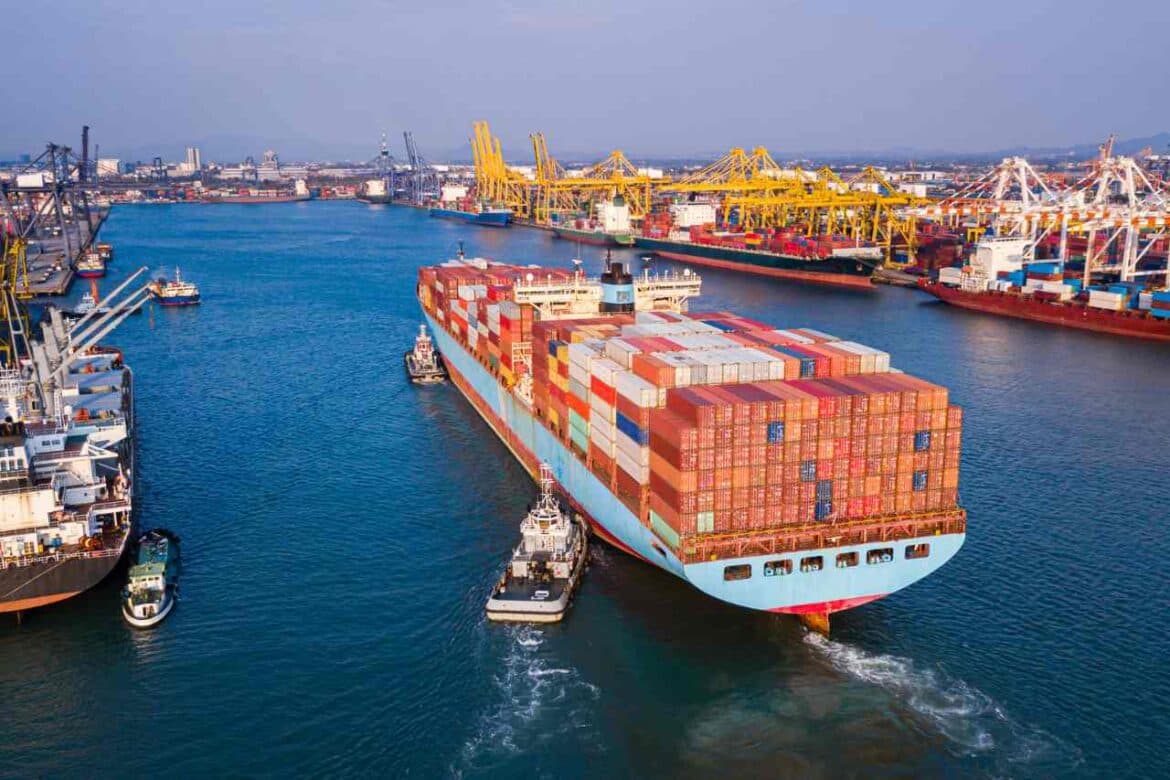
Anaklia sits on a stretch of Georgian coast with the deep water that larger vessels require — the reason the site was chosen. Georgia’s existing ports, Batumi and Poti, are shallower and more constrained, and Poti in particular has limited room to expand. A deep-sea port at Anaklia is designed to handle the largest container ships and to serve as a transshipment hub, which is what a corridor moving goods between Asia and Europe needs.
The port is also a piece of national infrastructure with a strategic dimension that goes beyond commerce. It lies near the administrative boundary with Abkhazia, a breakaway region over which Georgia has no control, and its development has been watched closely by Russia as well as by the West. The choice of developer therefore carries political weight, not just financial: the port is a chokepoint for trade, and control of it is leverage.
The regional logic is why the project matters well beyond Georgia. The Middle Corridor runs through Azerbaijan’s ports on the Caspian, across Georgia, and out to the Black Sea; its capacity is set by its weakest link, and the sea port is usually the link with the longest lead time and the largest capital cost. Anaklia is the corridor’s outlet, and its fate is bound up with Azerbaijan’s and the wider region’s trade ambitions.
Sources: Jamestown Foundation, Georgia’s Anaklia deep-water port becomes a Chinese geopolitical project (2024); AU.GE, Georgia begins active construction of Anaklia.
A project that has already failed once
Anaklia’s history is a cautionary tale about megaprojects in contested political environments. The original scheme, with an estimated cost of around $2.5 billion, was to have begun in 2017 with a consortium and a package of state support including a reported $100 million in government finance. It broke down amid disputes between the government and the consortium, leading to arbitration and the project’s collapse around 2020.
Reviving a failed megaproject is harder than starting a new one. Contractors, lenders and shipping lines all read the record, and the terms struck second time around tend to reflect the risk that the first attempt demonstrated. Georgia’s decision to take a controlling 51 per cent state stake was, in part, an answer to the earlier failure: it gives the government more leverage over a project it cannot afford to see stall. It also means the state carries most of the risk and most of the cost.
The 2026 budget reduction is the latest twist in that longer story. Cutting the allocation does not cancel the project — construction is under way — but it changes the financing model and the timeline, and it signals that the government is reprioritising its commitments. For a corridor that depends on predictable capacity, uncertainty about the port’s schedule is itself a cost.
Sources: DredgeWire, Georgia cuts funding for Anaklia deep-sea port in 2026 budget; AU.GE, active construction begins.
Who builds the gateway
The award of the tender to a Chinese-Singaporean consortium changed the project’s strategic character. Analysts have described Anaklia as becoming a Chinese geopolitical project, on the argument that control of a Black Sea deep-water port gives Beijing a foothold at a junction of the Middle Corridor and increases its influence in the region. For Tbilisi, the trade-off is between the capital and construction capacity that a large foreign developer brings and the strategic dependence that comes with it.
Other powers have interests too. The EU and the United States have supported the Middle Corridor as a route that reduces dependence on Russia and Iran, and a Western-aligned port would fit that vision; China has its Belt and Road ambitions; Türkiye, Russia and the Caspian states all have stakes in how the corridor develops. A port that changes hands, or whose financing comes with strings, becomes a barometer of which influence is winning.
The environmental and social dimensions of a major port are familiar: land reclamation and dredging, impacts on coastal habitat and marine life, the pressures that come with a port city, and the long-term emissions of the vessels and freight it handles. A deep-sea port is a piece of national infrastructure with a fifty-year life, and the decisions taken about its construction and operation determine its environmental cost as much as its economic return.
Sources: Jamestown Foundation, Anaklia and Chinese influence; RFE/RL, the Black Sea region in the new energy and trade order.
The Middle Corridor as an alternative route
The Middle Corridor — sometimes called the Trans-Caspian International Transport Route — is the overland-and-sea route that connects China and Central Asia to Europe via Kazakhstan, the Caspian Sea, Azerbaijan, Georgia and the Black Sea. It has existed for years but handled a fraction of the volume that moved through Russia. The war in Ukraine changed that by making the northern route through Russia politically and practically unattractive, and the corridor’s traffic grew as a result.
Its constraints are the ones that have always limited it. Crossings of the Caspian are slow and depend on ferries and vessels that are in short supply; the ports along the route, including Baku’s and Georgia’s, have had to expand; and the number of border crossings, customs regimes and gauge changes makes the route more complex than a single sea voyage. A deep-sea port at Anaklia addresses only the last leg, but it is the leg where the largest ships must be accommodated.
For Azerbaijan, the corridor reinforces a role it has played since the oil era: the hinge between the Caspian and Europe. Its ports, railways and now its electricity links are all part of that position, and the country benefits when the corridor works. The port at Anaklia is therefore not a Georgian project alone — it is a piece of infrastructure that the whole route needs, which is why its delays matter beyond Tbilisi.
Sources: AU.GE, Anaklia and the regional route; Hürriyet Daily News, regional transport and energy links.
What to watch
Three things will show whether Anaklia becomes a working gateway. The first is whether the funding cut is reversed, replaced by private or foreign investment, or allowed to slow the build — the port’s timeline is the clearest indicator of Georgia’s commitment. The second is the identity and terms of the final developer and operator, because that determines whose influence the port carries into the long term. The third is the corridor’s actual volumes: if Middle Corridor traffic continues to grow, the port will be built because the trade demands it; if the route settles back to a niche, Anaklia will struggle to justify its scale.
What the project already illustrates is the way infrastructure in this region is never only about logistics. Ports, pipelines, cables and railways across the South Caucasus are simultaneously commercial assets, instruments of state strategy and pieces in a contest between larger powers. Anaklia is the clearest example of the pattern: a port that was revived by a war, redesigned by politics, and is now being built under a financing model that no one would have predicted in 2022.
Key points
Georgia revived the Anaklia deep-sea port in 2022 after the war in Ukraine reordered Black Sea trade and boosted the Middle Corridor. The state took a 51 per cent stake; a Chinese-Singaporean consortium won the tender; construction began. In 2026 Georgia cut the project’s budget allocation, changing the financing and timeline. Anaklia is the sea outlet of the Middle Corridor and therefore matters to Azerbaijan and the wider region, not only to Georgia.
Sources: DredgeWire, budget cut; Jamestown Foundation, ownership and strategy.
Primary sources and news citations
- Jamestown Foundation, Georgia’s Anaklia deep-water port becomes a Chinese geopolitical project (2024).
- DredgeWire, Georgia cuts funding for Anaklia deep-sea port in 2026 budget.
- AU.GE, Georgia begins active construction of Anaklia deep-sea port.
- RFE/RL, Hungary, Romania, Georgia, Azerbaijan agree to Black Sea electricity project.
- Hürriyet Daily News, Azerbaijan to export renewable energy to Türkiye via Nakhchivan.
Methodology and sourcing. Project history, ownership and funding status are drawn from the reporting and specialist analysis cited and are presented as reported positions; Anaklia remains under construction and its financing model is subject to change. Figures on the original scheme are as reported at the time. This report describes the position as at September 2026.

Latest Episode
S7, E4: Infrastructure vs Nature Is the Wrong Fight: Joel Humphreys