


Neurosustainability: How the Built Environment Shapes Brain Health, Ageing & Resilience
- Jackie De Burca
- February 23, 2026
Neurosustainability: How the Built Environment Shapes Brain Health, Ageing & Resilience
What if “healthy ageing” isn’t just about genes, diet, or healthcare — but also about the streets you navigate, the air you breathe, the noise you sleep through, and the buildings you spend 90% of your life inside?
“This conversation makes the case for a shift: from sustainability as a materials-and-energy conversation, to neurosustainability — designing environments that protect sleep, reduce stress load, support movement, and build cognitive resilience across the lifespan.” Jackie De Burca
Listen below or on your favourite podcast app
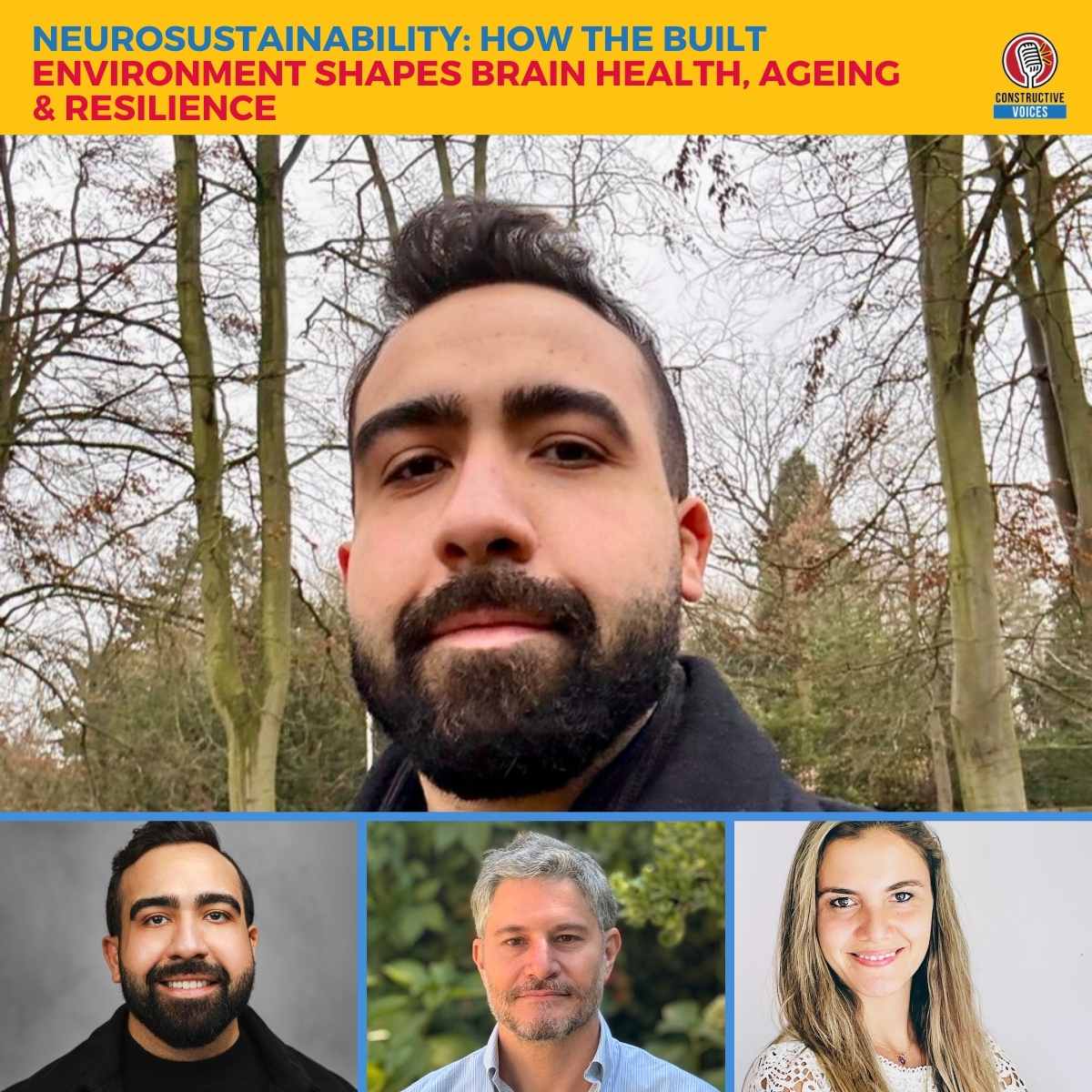
Host: Mohamed Hesham Khalil – Creator of the Neurosustainability theory, architect and neuroscience researcher, and a PhD candidate at the University of Cambridge.
Guest: Professor Agustín Ibáñez — Director of Global Research Networks at the Global Brain Health Institute (Trinity College Dublin) and Scientific Director of the Latin American Brain Health Institute
Guest: Burçin Ikiz — Neuroscientist and brain health advocate working at the intersection of climate, equity, and brain outcomes
Brain health isn’t only personal. It’s environmental. And the places we live, move, and work in can either build resilience — or quietly chip away at it.
“The built environment… is the space where we most of the time live, move, think and also thrive or become sick.” — Professor Agustín Ibáñez
In the third part of this mini-series about neurosustainability, Cambridge scholarship student, Mohamed Hesham Khalil sits down with Professor Agustín Ibáñez and Burcin Ikiz to connect the dots between climate, inequality, urban design, and the ageing brain.
They unpack the exposome and zoom into the built environment as the missing middle layer we can actually change.
“Scientists sometimes we use strange words for simple things.” — Professor Agustín Ibáñez
What is the exposome?

The exposome is the full set of environmental influences (physical, social, and economic) that shape our health and behaviour over time — and why the built environment is the missing “mesoscale” link between global forces (like climate change and inequality) and individual brain outcomes (like cognition, dementia risk, and mental health).
“I always see that the built environment itself maybe hasn’t been given the same attention… because… people spend around 90 percent of time indoors.” Mohamed Hesham Khalil
The discussion moves from greenness and air pollution to navigation complexity in cities, indoor air quality, heat, sleep disruption, and the urgent need to reframe sustainability as neurosustainability — designing spaces that support brain plasticity, cognitive reserve, and resilience across the lifespan.

“If you’re going out… with pollution… noise… and… light… that kind of stimulation can be actually really bad for the brain.” Burcin Ikiz
Important Takeaways
1) The exposome is the full environment of your life
Not just air pollution and heat — but also education, safety, housing, and inequality. All of it shapes health and behaviour over time.
2) The built environment is the “middle layer” we can redesign
Between huge macro forces (climate, inequality) and individual outcomes (sleep, cognition), the built environment is the neglected middle ground — and a realistic place to intervene.
“Built environment… provides… the opportunity to modify the inner environments.” Professor Agustín Ibáñez
3) City complexity can train — or strain — the brain
Complex navigation can boost cognitive stimulation, but as cognition declines, it can become a barrier. The challenge: ageing-friendly and dementia-friendly cities.
4) Indoors is the real battlefield
People spend most of their time indoors — and improving air quality, comfort, light, and noise where life actually happens can be one of the most direct interventions available.
5) Equity is not an add-on — it’s the headline
Green space helps if it’s clean, safe, and accessible. But noise, light, heat stress, and pollution can turn “stimulation” into harm.
“It’s really important that we really show everyone that it’s a shared responsibility… scientists, architects and policymakers… it’s not just a sole responsibility, but really every step counts.” Mohamed Hesham Khalil
Practical design + policy signals that come through clearly
This episode surfaces “brain-supportive” moves across scales — from homes to cities:
1. Healthier indoor air and thermal comfort, especially for older adults
2. Noise reduction and sleep protection as non-negotiables
3. Shared spaces and intergenerational housing to reduce isolation
4. Wayfinding and navigation support that helps people age well
5. Climate adaptation and clean air policies framed as brain health strategies
“Work with the local governments… city planners… implementing… regulations that will clean the air… bring green spaces… accessible.” Burcin Ikiz
Professor Agustín Ibáñez
Prof. Agustín Ibáñez is a global leader in brain health, serving as Director of Global Research Networks at the Global Brain Health Institute (Trinity College Dublin) and Scientific Director of the Latin American Brain Health Institute (BrainLat, Universidad Adolfo Ibáñez).
His research bridges computational neuroscience, aging clocks, exposome science, whole-body health, and artificial intelligence to advance understanding of brain health across diverse populations.
Author of over 500 publications and recipient of major international grants (NIH, NIA, Wellcome Trust, Alzheimer’s Association), he leads multicentre initiatives such as ReDLat and CliCBrain, promoting equitable, transdisciplinary approaches to precision brain health worldwide.
Mohammed Hesham Khalil
Creator of the Neurosustainability theory. a PhD researcher and guest lecturer at the University of Cambridge, a former graduate student at Harvard University, a joint researcher at University College London (UCL), and a member of Sigma XI, an international invitation-only honour society for scientists and engineers.
His work explores the relationship between environmental enrichment, neurogenesis, and the built environment, with the aim of developing a practical framework for neurosustainability in architecture and urbanism.
Discover more about Mohamed H. Khalil here.
Burçin Ikiz
Burçin Ikiz is a neuroscientist with over two decades of experience in brain health research and a leading voice on how climate and environmental exposures affect the brain.
She is the founder of the Neuroclimate Working Group and the director of EcoNeuro.